How eco-anxiety fuelled this young leader’s journey

By Armaan Makhani

My journey will not sound like the usual origin story of a climate advocate, but that might make it all the more important to share.

It was my first year studying Health Sciences at McMaster University - something I had looked forward to for years. But because of covid-19, instead of lecture halls and new friendships, I was sitting in my childhood bedroom staring at a laptop screen as one Zoom lecture blurred into the next. The pandemic days felt repetitive and distant from anything real.

So when I came across an environmental science elective that required us to actually go outside to collect forestry field data, I signed up without much hesitation. I wasn’t trying to ‘change the world.’ I didn’t have a lifelong passion for protecting the environment. I just wanted an excuse to get outside.

Before that course, climate change was something I cared about in the abstract. I knew it was important, urgent even, but it lived in headlines and documentaries.

That changed the first time I was asked to slow down and observe the world around me - to measure trees, collect soil samples, and notice patterns I had never paid attention to before. It made everything feel closer. 

But with that closeness came something I wasn’t expecting: anxiety. The more I learned, the heavier it felt. Climate change stopped being a distant issue and started feeling like something already shaping the future - our future. I remember thinking: How are we supposed to fix something this big?

As I continued taking sustainability courses, working toward my minors in sustainability and community engagement, that feeling didn’t go away. If anything, it grew stronger. When I later became a Sustainability Teaching Assistant, I started hearing the same thing from others. Students would enter tutorials carrying not just curiosity, but fear, frustration, and a sense of helplessness.

It soon became clear that this wasn’t just my experience - it was shared. In fact, three out of every four Canadians feel that climate change impacts their mental health.

For a long time, I didn’t know what to do with that feeling. There wasn’t a single moment where everything clicked - no dramatic turning point. Instead, it was a gradual shift shaped by people, conversations, and small actions that started to add up.

I began to see that my interest in health and my growing passion for sustainability weren’t two separate paths - they were intertwined. This realisation changed the questions I was asking. Instead of wondering whether my actions could make a difference, I started wondering where I could contribute.

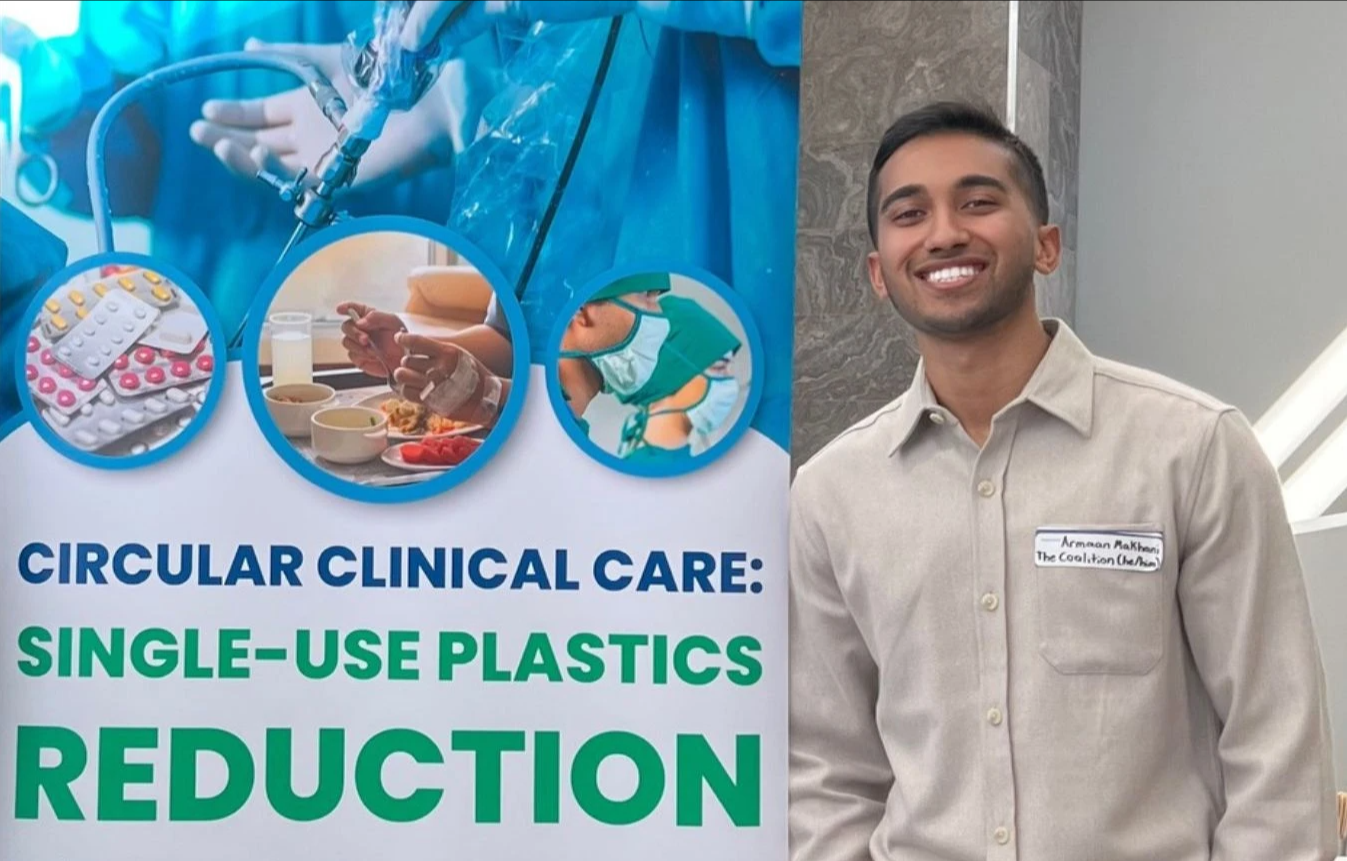
I got involved in research on single-use plastics that informed campus policy, helped lead the Student Sustainability Ambassadors Program to create spaces to transform climate anxiety into action, and started a fund supporting marginalised students with sustainability initiatives.

Over time, something shifted. The climate anxiety didn’t quite disappear, but it started to change. It became fuel and motivation to do more.

The deeper I got into this work, the more I realised that climate change isn’t just an environmental issue - it’s a health issue, and more than that, it’s an equity issue. The communities most affected by climate change are often those already facing systemic inequities, with the fewest resources to respond to disproportionate heatwaves, poor air quality, and limited access to care.

Health doesn’t exist in isolation. It’s shaped by the environments we live in - the air we breathe, the water we drink, and the systems we rely on. There’s an inspiring quote first published by The Lancet, that I often turn to:

“Climate change is the greatest global health threat facing the world in the 21st century, but it is also the greatest opportunity to redefine the social and environmental determinants of health.”

Today, I’m proud to work on a national, interdisciplinary project team at the Canadian Coalition for Green Health Care, supporting efforts to transition Canada’s health system toward net-zero. My work involves developing educational resources, exploring low-carbon technologies, and leading conversations on how we can reduce emissions in healthcare buildings while strengthening resilience. It’s technical at times, but it’s still about people.

It’s about recognising that the buildings we design, the energy systems we use, and the decisions we make in healthcare all have real consequences for human wellbeing. So we must keep asking: how can we do better?

What has surprised me most is how powerful it is when people are given space to engage with this work in a meaningful way. I’ve seen students enter class overwhelmed and leave with a sense of purpose, small ideas grow into institutional change, and momentum shift when people realise they’re not alone.

Hope, I’ve learned, is not something to wait for. It’s something to build - together as a society. I don’t become hopeful by ignoring how uncertain and serious things are. I become hopeful by staying connected - to my faith, to community, to the natural world, and to the stories of people who show up, in big and small ways, to create change.

I remind myself that my own journey didn’t start with a grand plan. It started with a single, almost accidental decision. Which makes me think: how many others are out there right now, one opportunity away from finding their way into this work?

Throughout this journey, I’ve worked to weave together health, equity, and climate action - threads too often kept apart. I’ve also tried to help young people step into their own power as leaders rather than bystanders by transforming climate anxiety into agency.

The recent increase in environmental sustainability dialogue within our Jamat, alongside the honour to be named one of Canada’s Top 30 Under 30 Sustainability Leaders, has further ignited my drive to support Ismaili youth as they transform into trailblazers within this space. And if there’s one thing I’ve learned, it’s that we can’t leave this kind of transformation up to chance!

This piece was originally published on the.ismaili on April 7 2026.

Waterkeeper: how water can be a blueprint for peace

For Bashar Alshawwa, water is not just a basic need — it is both the heart of global inequality and the key to peace. After decades of occupation, exile and war, he is working to turn a weaponized resource into a bridge between peoples.

Bashar Alshawwa thinks Canadians are spoiled. He’s immediately apologetic as he admits this, smiling sheepishly — and questions out loud if he even has the right to say that as a newcomer to Canada from the occupied West Bank. But to him, being able to turn on the tap at home at any time — and get clean water on demand — is a new kind of “heaven” that he thinks most Canadians don’t appreciate enough.

“I’m enjoying the water here because, back home, we can’t drink the tap water for a million different reasons,” Alshawwa says. Among them: old, unrenovated water systems. Pollution. And, crucially, the lack of access, control and ownership of water itself due to Israel’s long-standing occupation of Palestine.

What this new availability of unlimited clean water means for Alshawwa, his wife and four young children is that their relationship with water is changing. Now, he says, “I don’t care about taking a bath once every day or once every week or once every month, depending on the situation. I’m not worried if my kid needs a bath after a messy meal or, you know, a full diaper, because back home, we would use wipes and be very careful.”

And yet, as Alshawwa enjoys this newfound freedom and access to water — not just to drink, but to be able to walk on the shores of a Great Lake or along one of the winding rivers in Toronto, where he now lives — he is watching his entire extended family in Gaza struggle to find it every day.

This water catastrophe dates back long before the military assault that began after Hamas’s attack on Israel on Oct. 7, 2023. Water has been at the source of Israel’s occupation of Palestine since 1948, during the Nakba. Nakba (النَّّكْْبََة), the Arabic word for “catastrophe,” refers to the violent expulsion and ethnic cleansing of more than 750,000 Palestinians from their villages by Zionist paramilitary groups to establish the state of Israel. Palestinians believed they would be home again in weeks, but more than five generations later, there are now more than seven million Palestinian refugees and internally displaced people globally.

Then, and again after the 1967 Arab-Israeli war, the first military decisions Israel made were about water, with the Israeli military taking complete control of all water resources and infrastructure in the West Bank, East Jerusalem and the Gaza Strip. Water was a key issue on the table during the peace agreements of the Oslo Accords, first signed in 1993, along with right of return, refugees, settlements and borders.

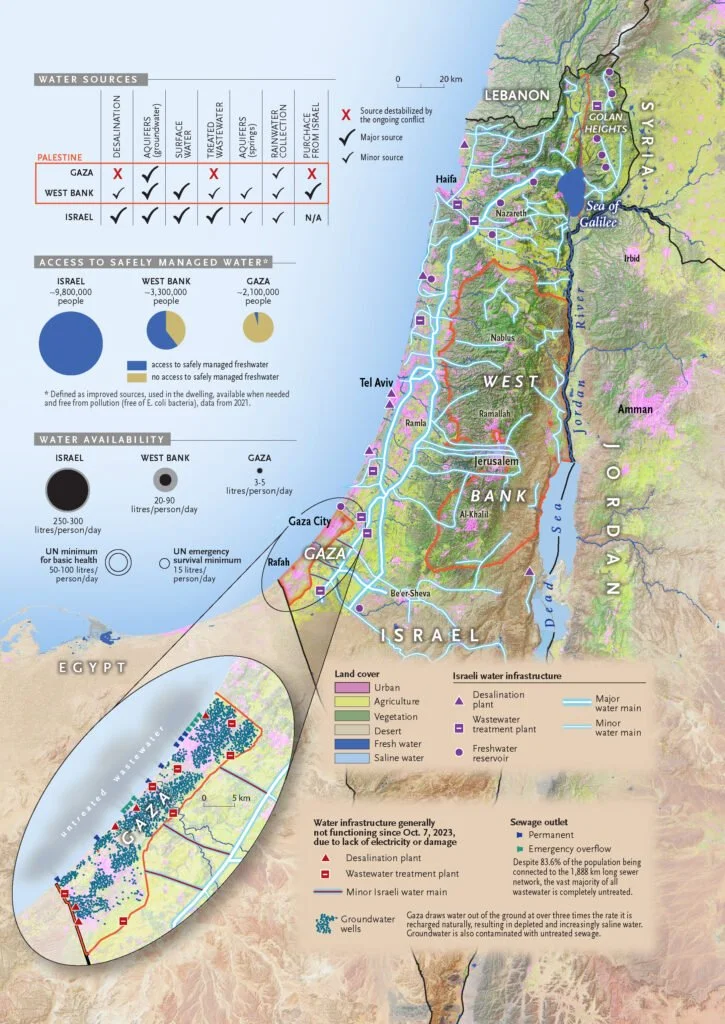
Map: Chris Brackley/Can Geo; Map data: Water sources: Fanack; Safely managed water: Palestine Central Bureau of Statistics, 2021; UNICEF; Cohen, 2024; Water availability: Palestine Central Bureau of Statistics/Palestinian Water Authority; Palestine Studies; Kramer et al 2022; World Health Organization; United Nations; Sewage, Gaza: Fanack; Pollution, Gaza: United Nations; GIS data: LANDSAT imagery, 2023: USGS; Land cover, 2020: Centre for Environmental Cooperation; Israeli water infrastructure: Mekorot; Gaza water wells: Salem & Isaac, 2007; Gaza water infrastructure: UNICEF, 2023

According to Amnesty International, “one of the most devastating consequences of Israel’s occupation is its discriminatory policies on Palestinians’ access to adequate supplies of clean and safe water.” Almost 60 years later, these restrictions continue, preventing Palestinians from getting the water they need to live a dignified life. In 2012, the United Nations predicted that by 2020 the lack of clean water would render Gaza “unlivable.”

In the Gaza Strip, 97 per cent of fresh water is unsuitable for human consumption, and raw sewage pours into the Mediterranean Sea. Desalination plants that treat water work only occasionally because Israel controls the fuel, supplies and electricity that power the plants. Since October 2023, the Israelis have repeatedly bombed these desalination plants and other water infrastructure, then hindered efforts to repair them.

“The numbers are horrible back home,” explains Alshawwa. According to Fanack Water, a Dutch organization that raises issues of water scarcity in the Middle East and North Africa region, some Palestinian communities only receive under 30 litres per day. (The World Health Organization recommends a minimum of 100 litres per day.)  This shortage exists even though Palestinians in the West Bank are the landowners and the water well owners. But they don’t have access to these water wells due to Israel’s occupation and “ownership” of the water under Israeli law. Meanwhile, according to the Palestinian Water Authority officials, illegal Israeli settlers in the West Bank receive 400 liters per day, enjoying pools and water fountains. Alshawwa calls it “a huge injustice.”

This water inequality is something Alshawwa has lived through. “Where I used to live in Ramallah, we receive [water] once every one month. In other communities, once every four months,” he says. “That means that all your behaviour will change as a human: when do you take a bath? When do you water your garden? When do you clean your house? You can’t renovate your water pipes. You can’t deal with the existing water resources that you have under your house, because the law — the military law, the occupation law — prevents you from doing that.”

Back home in Ramallah, Alshawwa was working for EcoPeace, a non-profit organization bringing together Jordanian, Palestinian and Israeli environmentalists to foster peace through shared environmental issues such as water. The organization, which has offices in Amman, Tel Aviv and Ramallah, was founded in 1994 in the wake of the Oslo Accords and funded and supported in part by Canada.

EcoPeace sought to fill in the blanks of what the Oslo peace accords left out: real solutions to water and environmental concerns. The non-profit saw a rare opportunity for collaboration amid conflict: Jordan, Israel and Palestine all shared the same waterways. Alshawwa and his colleagues wanted to protect the basic human right to water. “It’s something undeniable,” he says. EcoPeace work gave him a clear-eyed entry point into the occupation and conflict in Israel/Palestine, one that’s often framed as religious. “No,” says Alshawwa. “It’s a war over resources.”

Occupation, annexation and war further threatened an already water-scarce region. EcoPeace saw the right to healthy, clean, accessible water as a powerful tool: one that united these countries with a shared responsibility — for themselves, and for each other. “We’re talking about mutual interest,” Alshawwa says. “These human values of equality and justice are not enough to protect the cause. This is reality.”

There’s no stronger case for water diplomacy than the Jordan River (Nahr al-Urdunn or نهر الأردن in Arabic and Nehar ha-Yarden or נהר הירדן in Hebrew), which springs from the mountains between Lebanon and Syria, slips through the Sea of Galilee and winds 360 kilometres down to the Dead Sea. Along the way, it delineates some of the region’s tensest borders — Israel with Jordan and Syria, and Palestine with Jordan — a landscape crisscrossed with fences and landmines. Decades of water grabs by Israel, Syria and Jordan have bled the river dry, leaving Palestinians without a share in its southern reach — and leaving nature with almost nothing at all. Today, roughly 96 per cent of the Jordan’s fresh water has been diverted. A river sacred to Jews, Christians and Muslims has been reduced in many places to a sluggish, foul-smelling trickle. “The Jordan River valley used to be the food basket for the Levant area, but it ended up like the Sahara because of the weaponization of water,” Alshawwa says.

When EcoPeace started its work on the river in 2005, the waters in which Christians believe Jesus himself was baptized thousands of years ago were drying up — and nearly irreparably polluted, owing to decades of competition over, and diversion of, the Jordan. EcoPeace estimates Israel diverts about half of the river’s average annual flow, while Syria and Jordan take the rest. Palestinians, denied access to the river, take almost nothing.

Yet, the Jordan River is the perfect case study for how effective “eco-diplomacy” can be. Through advocacy, campaigns and legal pressure, EcoPeace helped pressure the Israeli government to build a wastewater treatment plant in the Gaza Strip in 2021. The Israeli government also agreed to release water from the Sea of Galilee to the Jordan River. And EcoPeace also secured some access for Palestinians to the biblically significant shores of the Jordan. Nearby Al- Maghtas, where it is believed Jesus was baptized, became a UNESCO World Heritage site in 2015.

Despite these wins, Alshawwa laments the damage that has already been done. Pilgrims flocking to the holy shores of the Jordan River to be baptized are doing so in polluted water. “I feel sorry for that,” Alshawwa says.


One week before Oct. 7, 2023, Alshawwa and his colleagues at EcoPeace — including a Palestinian decision-maker, an Israeli decision-maker and a delegation of international diplomats — embarked on an advocacy tour in the “Gaza envelope,” the territory in Israel within seven kilometres of the Gaza Strip. What they saw was concerning.

Alshawwa can list in quick succession the factors that made this place a tinderbox. It was clear to him and his colleagues that Gaza, as it was, had no future. No jobs for youth. No security. No stability. No clean drinkable water. No facilities for electricity, nor for energy, not even enough to effectively treat waste, so waste was pushed instead into the open sea. No cement for construction: no pipes, no building materials, owing to Israel’s blockade — which restricted even toys, spices and jam, musical and writing instruments — let alone desperately needed supplies to rebuild infrastructure damaged in previous wars on Gaza.

“No one can accept living in such an unstable situation. Unfortunately, it took us a genocide to start worrying about that region,” says Alshawwa. “We didn’t expect the scale of October 7. We have been warning for many years that the apartheid ethnic cleansing regime is not only damaging Palestinians; it’s threatening the entire Middle East and the entire world.”

In late October 2023, Alshawwa and his colleagues at EcoPeace, along with a coalition of influential Israeli NGOs, experts and institutions, sent letters to Israeli Prime Minister Benjamin Netanyahu warning him that turning off the water supply to Gaza was against Israeli law and pressured him to reopen the taps, or they would take him to court. The U.S. administration was also pressing Netanyahu on this. This coalition met with Netanyahu’s team, and the government acquiesced. But it was a short-lived win. Israel opened the water connections in late October, but its military had effectively destroyed the water infrastructure within Gaza — so water arrived with no way to distribute it. 

EcoPeace was on the ground delivering water alongside partners in Gaza’s water, sanitation, and hygiene committee when six of the water sector workers were killed in an Israeli attack. “These were no accidents,” says Alshawwa. “These were coordinated activities that Israel had knowledge of. We shared all details of the car, the plates, where the teams will work, all their pictures and IDs. It was coordinated with the Red Cross, and they bombed them. They killed many people.” In a separate incident, Alshawwa lost a colleague: EcoPeace’s own engineer who supervised EcoPeace’s projects in Gaza. 

Today, the situation is catastrophic. “Nowadays in Gaza, oh my God… I don’t have enough words to explain,” Alshawwa says. “No words can explain that. In the shelters, you have to put one of your kids all day at the queue to the bathroom, just to reserve a place because it will take eight hours, 10 hours, to get your [turn] to use the toilet.”

Alshawwa adds that it’s women who bear the brunt of the lack of water access. “In the shelters, imagine women with their periods, with the lack of having tampons,” he says. “In some communities, women have to go from one place to another to wash clothes and to use water.” Mothers were already buckling under the pressure of parenting amidst the relentless military onslaught by Israel while also having to find food and water for their children. Alshawwa says this plan “to make life hell” for residents in Gaza is part of Israel’s plan of forcible displacement and ethnic cleansing.

But to Alshawwa and his colleagues at EcoPeace, there was an opportunity here: what if water could go from being the root cause of conflict to unlocking and solving it for good?

Alshawwa’s path to water justice was forged by a childhood spent in search of a home. He was born in 1985, a Palestinian refugee outside Palestine in Kuwait. During and after the Gulf War in 1990-91, close to 400,000 Palestinians were expelled from Kuwait — a form of collective punishment after the Palestine Liberation Organization had aligned with Saddam Hussein — forcing Alshawwa and his family to move to Iraq, a country engulfed in what he describes as an unlivable war. Next, they tried to make a home in Jordan, but owing to their status as refugees, he and his sister were unable to enrol in schools. They had to leave yet again, finding themselves in a Palestinian refugee camp in Damascus, Syria. That, too, was short-lived: Syria was living under a dictatorship, and Alshawwa says even finding bread was a struggle. Then came the Oslo Accords in 1993, a landmark agreement between Israel and the Palestinian Liberation Organization in which Israel recognized the organization as a legitimate authority representing the Palestinian people. Alshawwa’s father returned to Palestine, and the family joined him a year later, in 1995.

Being in Palestine for the first time after a lifetime of displacement was “bliss,” Alshawwa says, a reprieve from not being “the other.” A feeling of safety, of being home — finally. But less than a decade later, that positivity began to crumble for Alshawwa with the beginning of the Second Intifada, a major uprising by Palestinians against Israeli occupation that began in 2000 and continued for five years. This difficult time made Alshawwa re-examine his decision to stay in Palestine. “I lost friends, classmates and… and seeing everything collapsing with zero future,” says Alshawwa. “I knew if I stayed I would never make it.”

Alshawwa moved to Russia to attend Vladimir State University, about 200 kilometres east of Moscow. He’d received a scholarship to study biomedical engineering, which married his interests in becoming an engineer or a doctor. He “saw life” there, and that it could be “huge and big.”

This was the dream for many young Palestinians — to fulfill the responsibility of studying abroad, then come home to build, bringing back all they’d learned to Palestine.

He “saw life,” and that it could be “huge and big.”

Five years into that dream return, it shattered with a single bullet that tore through Alshawwa’s leg. A friend had invited him to a “peaceful protest” against the 2014 Gaza War. Protests, as far as Alshawwa knew, meant lighting tires on fire or throwing rocks. This was not that. It was “one of those European protests with candles.” It was called the “march of مسيرة 48 ألف) ” 48,000) and the plan was for Palestinians from communities all over the West Bank to march about 14 kilometres to the border with Jerusalem. They would sit at the Qalandia checkpoint until Israel ended its offensive on Gaza. Alshawwa went with his sisters, his nieces and his girlfriend, Arwa — now his wife. They marched carrying candles and signs. They reached the checkpoint. Then, the shooting started. Alshawwa, no stranger to rubber bullets, realized with horror that Israeli soldiers were shooting live ammunition.

“I was lucky because, when they started shooting, I just hid behind a small piece of concrete,” Alshawwa says. What he didn’t realize was that there were also Israeli snipers positioned overhead on military towers. He remembers a man next to him screaming that there was a laser pointed at Alshawwa’s head as he was crouching behind the concrete barrier. He knew he had to move — fast.

Alshawwa stood up to run and took the bullet in his leg. When an ambulance tried to rescue him, the Israelis shot at it. Medics arrived on foot. Israeli soldiers fired at the medics. Alshawwa says the soldier who shot him just “wanted me to bleed to death.” In the end, he crawled to reach the ambulance. That’s all he remembers until he woke up after surgery. It took 52 stitches to repair the damage caused by the bullet.

It took Alshawwa three days to come back to himself. He’d lost a lot of blood and was on a dizzying combination of painkillers and morphine. Visitors rushed to see him at the hospital and share what had happened. His mom and sisters had wept the day he was shot after hearing someone had been killed in the protests. “They thought I was dead,” remembers Alshawwa. “It was painful. I can’t really even remember what happened.”

Two weeks later, he started to wonder what he was even doing in Palestine. It would take almost a year and many other surgeries to walk again. Meanwhile, the war raged on. By the time a ceasefire agreement was reached, 2,251 Palestinians had been killed, 11,231 were injured and some 18,000 houses were partly or fully destroyed. At the time, Alshawwa says, he abandoned the possibility of peace with this “apartheid regime.”

“Sitting on the couch for one year gives you all this negativity and anger,” he recalls of his recovery. “Until this moment, I’m paying the price for being Palestinian.”

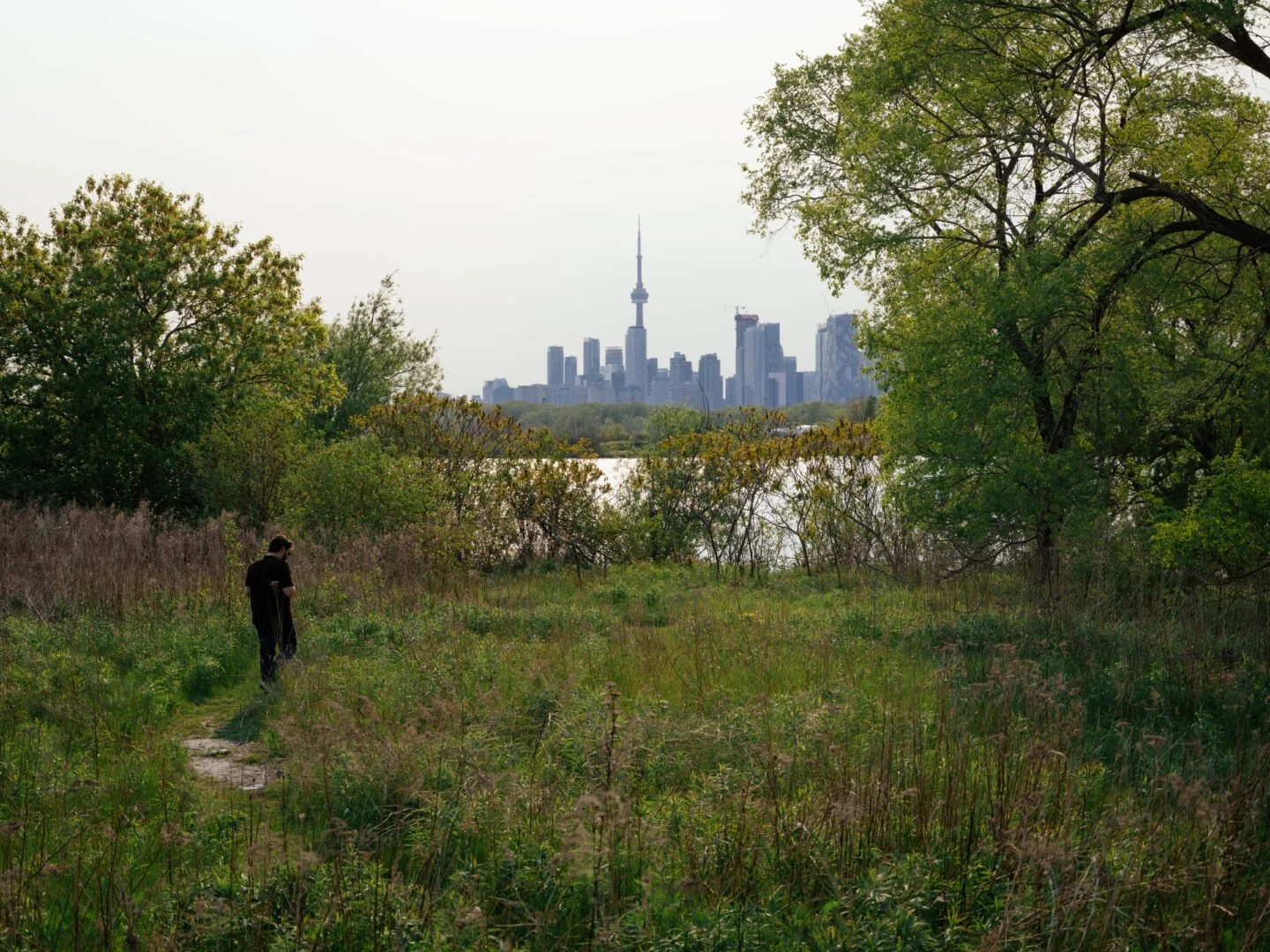
Alshawwa walks alone as the Toronto city skyline rises above Lake Ontario.

Three years after his painful recovery, the birth of his first daughter, Luna, changed everything. “I promised myself to do whatever I can do to make her future better than my history. I don’t want her to face the same messed up childhood I had,” Alshawwa explains. Within seconds of holding her, “I felt responsible for her. It’s not her fault to be born Palestinian.”

Alshawwa found a way forward. In 2018, he began to work in conflict resolution with EcoPeace. Understanding how crucial access and rights relating to water were to solving a decades-long imbalance between Israel and Palestine made him think: maybe water was the key to unlocking a better life for his new baby. He followed that thread, going on to receive a master’s degree in conflict resolution and development, specializing in water security and water diplomacy.

Water has no borders, he says. Take Gaza, for example, with its lack of power to treat wastewater. It was not only Gaza’s shoreline being polluted with wastewater and losing its biodiversity, but Israeli beaches and those in neighbouring Egypt. “So it’s not only a Palestinian problem now; it’s an Israeli problem,” says Alshawwa. “It’s an Egyptian problem. It’s an international problem.”

“I felt responsible for her. It’s not her fault to be born Palestinian.”

While the work is long, heavy and often uphill, Alshawwa has no shortage of success stories that prove environmental rights, water rights and human rights can be the building blocks for a better life: EcoPeace’s work has prevented land confiscation, stopped the building and expansion of illegal Israeli settlements and prevented the demolition of houses, according to Alshawwa. As director of advocacy, Alshawwa was leading the teams doing this work. They’d start by going to Israeli military courts, sometimes even taking their cases to Israel’s supreme court and international courts.

For years after Luna’s birth, Alshawwa turned down job opportunities outside Palestine, not wanting to miss his chance to stay and live at home after a lifetime of exile and displacement. That calculation changed after October 2023.

“When we started counting bodies… I just looked at Luna, and I said, ‘Maybe it’s my mistake, my decision to stay home, but it’s not her fault.’” He and his wife decided to take their children and leave the country, at least until things calmed down. Alshawwa feared there were no limits to the violence underway. “We had horrible stories,” said Alshawwa. “I have people with names, memories, with lives, kids killed just for being there.”

In June 2024, Alshawwa saw his opportunity. He’d learned there were special measures for Israelis and Palestinians affected by the war to come to Canada and receive a work or study permit for up to two years. While in Canada to represent EcoPeace during meetings with the Canadian government, which supports EcoPeace’s work, he told his team that he intended to take advantage of these special measures and stay in Canada. He resolved to make a life for himself and his growing family.

The leadership at EcoPeace sprang into action to help make Alshawwa’s dream a reality. They reached out to their contacts through the Waterkeeper Alliance. The alliance, which EcoPeace joined in 2009, is a worldwide network of over 300 water organizations working to protect more than 15.5 million square kilometres of rivers, lakes and waterways on six continents. Alshawwa was connected with waterkeepers in Ontario, who share his passion for protecting waterways, addressing water scarcity and seeing water as a powerful conduit for peace through international co-operation.

It took 10 months for Alshawwa’s family’s applications to be approved while he stayed in Canada. “It wasn’t easy,” he said. “The process, the bureaucracy…[and] holding a Palestinian passport.”

In July 2024, Alshawwa missed the birth of his fourth child, a son named Khalil, while still navigating the reams of paperwork that would bring his family to Canada. He FaceTimed them often, and he watched Khalil grow with every call. He smiled when Khalil grew to recognize his father’s face through the screen.

Eight months later, on March 28, 2025, Alshawwa stood nervously at the arrivals hall at Pearson Airport, waiting for the doors to part for his wife, Arwa, along with their children Luna, Maya, Majed and Khalil, now seven months old. Two of Alshawwa’s friends stood by his side. One held a big, square balloon, while the other held a hand-drawn sign that read: “WELCOME TO CANADA,” along with the children’s and Arwa’s names in colourful lettering.

An hour went by. All around him, Alshawwa and his friends watched families and friends reunite, hugging, laughing, shedding tears. He grew anxious. Had something gone wrong? Where were his wife and kids? Alshawwa recalls his back seizing in the painful way that it does when he is on edge. Two hours passed.

Alshawwa’s heart sank. He began to think the whole Canadian dream was naive, and perhaps it was time to abandon it and book his own ticket back home to Palestine.

Then, the doors parted, and through them ran his daughters, Luna and Maya, straight into his arms. “When I just saw them, everything disappeared,” Alshawwa says.

Then he saw Khalil for the first time. Any fears that his newest son wouldn’t recognize him evaporated. “This little incredible kid, he knew me,” Alshawwa says, wide-eyed with wonder as he remembers Khalil’s recognition of a father he’d never met.

Alshawwa laughs with his daughters Luna (right) and Maya (left).


A few weeks later, slate-coloured skies and a warm breeze envelope the auditorium at the Toronto Reference Library in downtown Toronto, as it fills with hundreds of attendees in purple T-shirts. It is the Canada Peace Summit, a full day of panels, conversations and dialogue designed to “engage Palestinians and Jews in dialogue.” The event was organized by Toronto Friends of Standing Together, a community of Torontonians who are supporters of Standing Together, an Israeli social grassroots movement aiming to end the occupation and achieve peace and equality. Alshawwa is standing just outside the auditorium, looking sharp in his suit, Arwa beaming at his side.

Alshawwa is very clear about why he’s here to speak today. “It’s our story, our cause,” he says. He says Palestinians are often pushed out of the frame when talking about their very futures, and he doesn’t want to waste an opportunity to claim the conversation. He also sees it as an opening: nothing is as polarizing as talking about Israel and Palestine, and people are divided, splintered, and far apart. This is an opportunity to bring them closer together under a massive metaphorical tent of people who care deeply about the future of Palestine and Israel.

“People are standing on the edge,” Bashar says. He has a plea and invitation to anyone who may be reluctant: “If you want to make a change, here is a partner for change. Come on board.”

It is mere minutes before Alshawwa is due to take the stage, but first, there’s something he wants to do. He excuses himself with a flash of a smile. “I’m going to go make a membership at the library [for] my kids.”

Moments later, Alshawwa takes the stage. He is nervous but speaks clearly and emphatically.

“I’ll start by the words weakness — weakness, helplessness, oppression,” says Alshawwa. “These are not just emotions. They ache like a wound, a pain that seeps into your bones and your spirit. My experience has never been easy. For most of my life, I believe I was powerless.”

For the next few minutes, he holds the room’s rapt attention as he tells his life story — and his refusal to give into the anger and rage that consumed him after he was shot in 2014. 

 “I was born a Palestinian refugee from Gaza, outside Palestine, and had a childhood without a childhood. I was without stability. I don’t remember a school I stayed in or a childhood friend. We were always on the move. We were chasing safety. Then came a chance: I returned to my homeland after the Oslo Accords, only to be shocked by a brutal reality: occupation, violence, death, injustice. At that time, I did what anyone would do, and I tried to tell myself I was like everyone else — that I can, I can, or I could, cope with that. Then a sniper’s bullet shattered that. I was shot by an Israeli soldier. I couldn’t walk for a long time, and at that time I was spent with rage, pain and most of all, helplessness. I was helpless to move. I was helpless to reject the injustice. I remember being trapped in that feeling until the day I had my biggest achievement, when I had my beautiful daughter, Luna. And for the first time, everything changed in that moment… I found myself rejecting helplessness, rejecting weakness, rejecting the very oppression that had defined my life. I knew I had to try to fight for a change, for hope, not just for me, but for that beautiful kid. Since then, I have spent years building bridges, forming partnerships, trying to convince the status quo and rejecting the oppression. And I have to prove myself and to others that change is possible, that hope is not a lie. And then, unfortunately, this war started. And when this war began, and again, I lost loved ones, family, friends, uncles, aunts, nieces, nephews, colleagues in Gaza, the pain returned… My body collapsed at that moment. My gallbladder burst from distress and grief, and after waking up from the surgery, I faced the same question, the same test: would I return to being that helpless child, that victim, or would I remain the Bashar who chose to act, to never stop working for peace, for justice? Today, we are all facing that same test as individuals, as groups, as communities, societies, Jews, Arabs, Muslims, white, Indigenous. And this is a challenge, at the end, to our humanity, to our values, to everything we stand for. But we have a choice. Remember that we have a choice, a chance to create a change, to say no to helplessness, no to injustice, and yes to action, yes to responsibility, yes to protecting not just ourselves but the world that we all share. So change is possible if we want it, and that truly is our choice. Thank you for being here.”

The room hangs with silence for a moment after Alshawwa stops speaking. Then, the crowd rise to their feet, and Alshawwa stands amid a wave of thunderous applause.

THREE MONTHS INTO the war on Gaza, Alshawwa was in his office at EcoPeace’s Ramallah headquarters, trying to stay focused on his mission and work amid news of Israel’s relentless campaign of devastation. His boss walked in with life-changing news: he and his colleagues at EcoPeace had been nominated for the Nobel Peace Prize, recognizing three decades of environmental peace-building work and, notably, their work on the Jordan River. It was proof — and recognition — that water could truly be a tool of cooperation.

“This nomination is huge,” Alshawwa smiles. “Even Trump didn’t get it.”

The Nobel nod was especially meaningful to Alshawwa because the nomination recognized EcoPeace’s advocacy work — Alshawwa was, at the time, director of advocacy for the organization. “It came in the times of war, in the times of the genocide, and it came to give us hope that at least we’re not left behind, and someone outside is thinking about this.”

Then, Alshawwa says, “we continued our daily work,” pushing for Gaza to receive electricity, for the strip to be able to treat their own water, to stop raw sewage from polluting shorelines, for Palestinians to have access to water, and protecting the ancient biodiversity of the Jordan River Valley, one of the most important bird migration flyways in the world. Nobel nomination secured, it was time to get back to work: the storks, common pelicans, kingfishers, herons, shovelers, sandpipers, shanks, francolins and other globally threatened waterfowl were counting on him to keep going.

Today, Alshawwa and his family are having “good problems” in their new home. In the West Bank, school drop-offs and pickups involved monitoring for the threat of violence. Alshawwa had to be hypervigilant, because “being at the wrong place, wrong time will cost you your life.” Here, everyday problems look more like preparing for the upcoming fun fair, or the pool being closed for renovations at school. “We’re so grateful for this opportunity.… It’s a new life, a new beginning,” Alshawwa smiles.

But the home he’s left behind doesn’t stray from his thoughts. “When I see my daughters enjoying the life of Canada, I still remember my nieces [in Gaza] striving for water.”

The violence back home has shifted. Alshawwa has seen Israeli soldiers “shooting and laughing,” videos of Israeli soldiers celebrating their birthdays by bombing houses. Palestinians called the intentional and systematic destruction of their people a genocide long before the world caught up. Now, the UN Commission of Inquiry, the International Association of Genocide Scholars, Amnesty International and the government of South Africa (in a case at the International Court of Justice) have stated Israel’s actions in Gaza amount to genocide. Alshawwa says he fears what other atrocities will be discovered when they eventually stop — if they ever do.

Today, Alshawwa’s entire extended family is in the north of Gaza. On a good day, messages read, “We survived today.” Other days: “We lost someone today, and we’re counting bodies.” That’s to say nothing of the daily scramble for food and water, with Alshawwa doing his best to coordinate funds, logistics or both, to help them get it. That is in addition to his work in Canada leading the Water for Peace initiative at non-profit Swim Drink Fish and, more recently, working in advocacy and building inter-community relationships for C-Space, a conflict resolution firm.

Alshawwa says he wants to give up. Often. But he rejects the urge to give into despair. “It’s our cause. It’s our responsibility. Someone has to do it. It’s now or never. I would blame myself in the future if I did nothing.”

It’s sometimes thankless work, criticized by everyone around him. Alshawwa understands when people lose hope. But he also says that’s exactly what “the spoilers” want. Alshawwa says they exist not just on “both sides” but on all sides — those who benefit from keeping things exactly as they are: he names the Israeli government, as well as Hamas, the Palestinian Liberation Organization and the Palestinian Authority. But it’s also the wider international community, weapons manufacturers, Christian Zionists. All of them, he says, benefit from the status quo he is trying to change.

“There is no one villain in this story,” says Alshawwa. “There are many villains — and many victims and many heroes.”

Alshawwa won’t let the villains win and instead wants to be one of the heroes, for four very good reasons. Their names are Luna, Maya, Majed and little Khalil. The water Alshawwa is working to protect belongs to them, after all. “We don’t own water,” says Alshawwa. “We just inherited it. Our only mission is to protect it and to give it to our kids.”

This piece was originally published on Canadian Geographic on March 22 2026.

Green Ramadan Brings Sustainability to the Holy Month

A Conversation with Environmental Activist  Kori Majeed

By Ammarah Ahmed

When Muslims gather to break their fast at sunset during Ramadan, the moment carries a sense of reflection and gratitude shaped by hours of discipline and remembrance. For Kori Majeed, a faith-based environmental activist and mother of five in Maryland, it was during these blessed moments that she realized that something didn’t feel quite right. Watching how quickly single-use plastic cups were being discarded at mosque iftars revealed something she could no longer ignore.

“They had used them for less than a minute,” Majeed recalled. “I thought about how those same cups can take more than 500 years to decompose.”

The thought lingered. Each evening in Ramadan, she saw how quickly waste accumulated at the mosque, standing in stark contrast to the mindfulness fasting is meant to cultivate. What began as a moment of discomfort soon became a question of responsibility,  one that would shape her work for years to come.

That moment led Majeed to found Green Ramadan, a grassroots, faith-based initiative designed to help fellow Muslims live mindfully and sustainably. Based in Maryland, Green Ramadan operates at the intersection of Prophetic ethics, sustainable living, and community education helping transform mindfulness from an abstract idea into a lived practice.

What is Green Ramadan?

Green Ramadan was founded in 2013 as a mission-driven environmental justice initiative that encourages Muslims to approach the holy month with greater awareness of consumption, waste, and stewardship of the Earth. 

“Since 2013, I’ve used the Green Ramadan platform to encourage Muslims to eat mindfully and tread lightly by cultivating sustainable habits during the holy month,” Majeed said. “I consider it a personal sadaqah [charity] to my local community and to the Ummah.” Its mission is rooted in the belief that sustainability is not an external value imposed on Muslims, but one already embedded within Islamic teachings. 

Rather than operating as a traditional nonprofit or commercial enterprise, Green Ramadan functions as a community-centered initiative that blends environmental activism with spiritual reflection and responsibility. Majeed’s starting goal was to help 1,000 Muslims “green” their Ramadan. She hopes not only to reduce waste at community iftars, but also to spark ongoing conversations about how faith can guide more intentional and just relationships with the natural world. 

Through educational outreach, Green Ramadan offers practical tools that make sustainable choices accessible during one of the most spiritually significant months of the year.

From a Family Challenge to a Community Initiative

While Green Ramadan’s mission is rooted in faith, its impact has always been shaped by everyday practice. For Majeed, meaningful change did not automatically begin with a large-scale campaign, but with small, intentional choices made at home, choices that would ripple outward into the wider community.

“When I initially started the idea of Green Ramadan, my goal was to change my family’s Ramadan habits so that we would waste as little as possible,” she said.

That led to the creation of Zero-Trash Iftar Kits, which include stainless steel food trays, bamboo cutlery, and napkins designed for multiple uses  at communal iftars. Majeed and her family began bringing the kits to iftars and gatherings, using them quietly and consistently as an alternative to disposable utensils.

“At first, we got curious looks,” she recalled with a laugh. Those moments proved to be an opportunity to begin a dialogue with the community centered on environmentalism. That dialogue had a ripple effect. “Over time, people started bringing their own reusable utensils too.”

What began as a simple act of modeling sustainable behavior soon became a catalyst for broader change. She began assembling Zero-Trash Iftar Kits for others as part of the Green Ramadan initiative, selling them on her website, and giving them away during Ramadan.

Opening Eyes to Sustainability

Majeed’s daughter, Rahmah Majeed, is a third-year university student. She reflected upon childhood Ramadans fondly. Being involved in her mother’s work from a young age, she grew to value her role as a steward of the planet. As an adult, she could no longer ignore the environmental cost of community iftars. “At the end of every iftar, I would see several piles of trash bags filled to the brim with plastic plates,” she said. “When you multiply that by 29 or 30 days of Ramadan at countless masajid [mosques], the amount of trash becomes impossible to ignore.”

Rahmah praised reusable iftar kits as a practical first step. “Zero-Trash Iftar Kits are a great way to make a powerful impact.” She recalled how other environmental activists in the area quickly caught on. They described Zero-Trash iftar kits as a catalyst for positive change. Kesha Abdul Mateen, a mother like Majeed, described it as a “life saver for the soul.” 

“It was different, but it started something new in our community,” she said. 

Majeed recalled the kits gaining momentum. “I started giving presentations at mosques about Zero-Waste Iftar Kits. After a certain point, I lost track of how many we distributed,” she said. Majeed encourages people to get creative in crafting their own reusable kits, emphasizing convenience and resourcefulness suited to individual needs.

Since its founding, Green Ramadan has grown from a personal family commitment into a resource used by individuals, families, and Muslim communities across the Washington, D.C. area. And as interest grew in the community, so did the scope of Green Ramadan. Today, the initiative extends beyond the kits to encompass an educational platform with a growing following. 

Green Ramadan’s Educational Foundation

As Green Ramadan grew, Majeed recognized that education would be just as essential as physical tools to combat excessive waste. While reusable kits offered a tangible entry point, sustained change requires ongoing conversation that can reach people beyond local mosques and community gatherings.

Through Instagram, Majeed uses digital space as an extension of her environmental justice activism, sharing reflections on Islamic teachings, practical sustainability guidance, and reminders that mindful living is already woven into the faith. Her posts often connect everyday behaviors to Qur’anic principles and Prophetic practice. She also hosts frequent seminars focused on Green Ramadan alongside other faith-based environmental activists. 

Majeed said an online presence allows Green Ramadan to meet people where they already are. By pairing digital education with in-person organizing, Green Ramadan expands its reach while maintaining its grassroots ethos. The platform ensures that the teachings of environmental stewardship remain visible, accessible, and relevant throughout the year.

Growing Community Impact of Green Ramadan

As these efforts saw Green Ramadan expand beyond Majeed’s own household, its influence became most visible in the ways people began to rethink their daily habits. For many participants, the platform offered more than reusable tools; it provided a language and framework for aligning faith with action.

For Sameera Tahir, a 24-year-old graduate student in Texas, incorporating Green Ramadan practices led to meaningful shifts in both routine and mindset. She came across Green Ramadan online after exploring sustainable teachings in Islam. “The Green Ramadan platform reminded me that it’s actually my responsibility as a Muslim to live mindfully,” she said. 

Sameera  was initially reluctant to confront how much her daily actions might be contributing to wastefulness during Ramadan. But Green Ramadan reminders online sparked a change in her. “I made a conscious decision to approach my daily routine differently,” she said. “The biggest change for me was making sure I didn’t use excessive water when I made wudhu [ablution].”

She also drew inspiration from the Zero-Waste Iftar Kits, resolving to make her own during Ramadan. After making these small changes, she persuaded the rest of her family to start using reusable kits too. “It’s become a habit we now maintain at gatherings as much as possible,” she said.

Eventually, her awareness extended beyond her immediate circle. Through Green Ramadan, she discovered a broader network of Muslim-led environmental initiatives, opening the door to learning about communal sustainability efforts taking place at mosques and faith-based organizations. “Green Ramadan was the foundation for my lasting commitment to be more in tune with my faith and the natural world,” she said.

Starting Your Own Green Ramadan

For many who want to engage with Green Ramadan, the question that follows is: “What can I actually do?” Majeed emphasized that meaningful change does not require perfection, but intention.

For Majeed, sustainability is a direct expression of God-consciousness. “I like to think of Ramadan as boot camp for the soul,” she said. The structure and spiritual focus of the month, she explained, create an opportunity to build habits that extend into the rest of the year. Green Ramadan’s approach reflects that philosophy. Rather than framing sustainability as an added burden, the initiative emphasizes small, intentional changes rooted in Prophetic practice. Majeed recommended three easy core habits that anyone can implement in their daily routine:

  1. Use reusable materials

  2. Eat less meat

  3. Make wudhu like Prophet Muhammad (salla-Allahu ‘alayhi wa sallam)

Majeed believes sustainable living is about consistency. She often returns to her one of favorite Hadith, “Take on only as much as you can do of good deeds, for the best of deeds is that which is done consistently, even if it is little” (Sunan Ibn Majah, 4240). Taken together, these practices reinforce values already central to Ramadan: intention, moderation, and discipline. They also highlight sustainability as a natural extension of faith.

Today, Majeed continues to grow her Green Ramadan platform. She also chairs the Green Team at Masjid Muhammad – the Nation’s Mosque – in Washington, D.C., where she leads community-based efforts rooted in the Prophetic model of environmental justice. She hosts workshops aimed at helping people connect with the signs of Allah in the natural world, including monthly moon sightings, community planting, and educational excursions into local wildlife.

Kori Majeed is also the co-author of Forty Green-Hadith: Sayings of the Prophet Muhammad on Environmental Justice & Sustainability, an e-Book highlighting  sustainability within the Islamic tradition. You can learn more about Green Ramadan and environmental justice by following Kori on Instagram at @greenramadan.

Ammarah Ahmed is a Muslim-American journalist covering a wide range of topics spanning from Islamic identity to business, law, and politics. Passionate about fostering ummatic agency, she has written  articles that highlight the impactful work of Muslims across the globe. She also holds an LL.M. from SOAS, University of London, where she studied International Law, Human Rights Law and Islamic Law.

This piece was originally published on Islamic Horizons on March 5 2026.

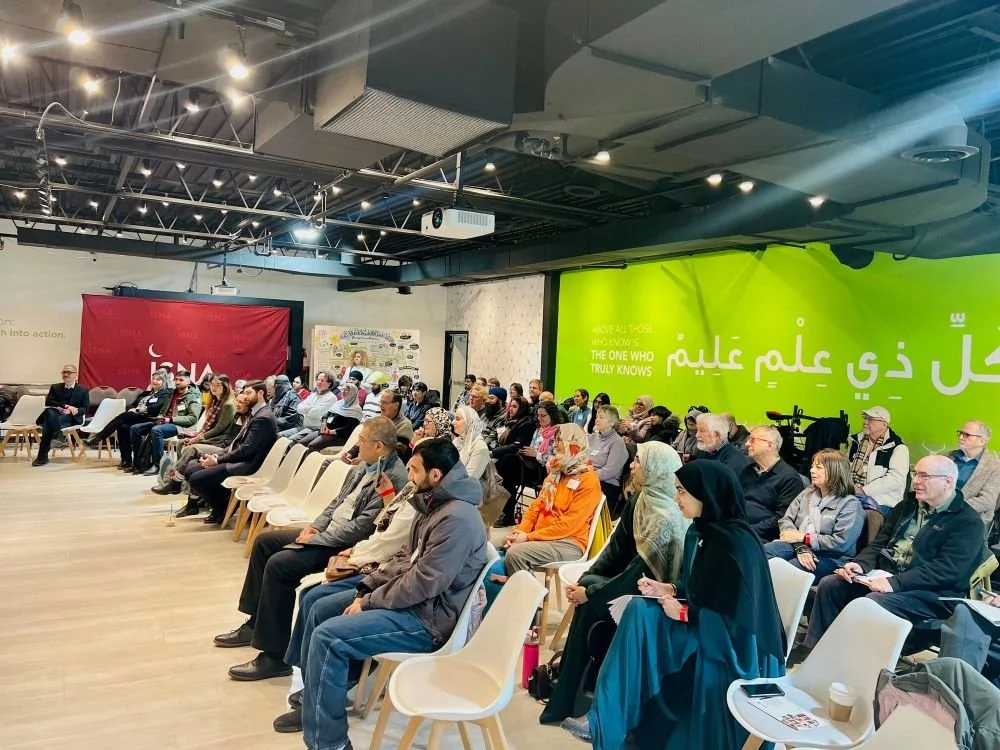
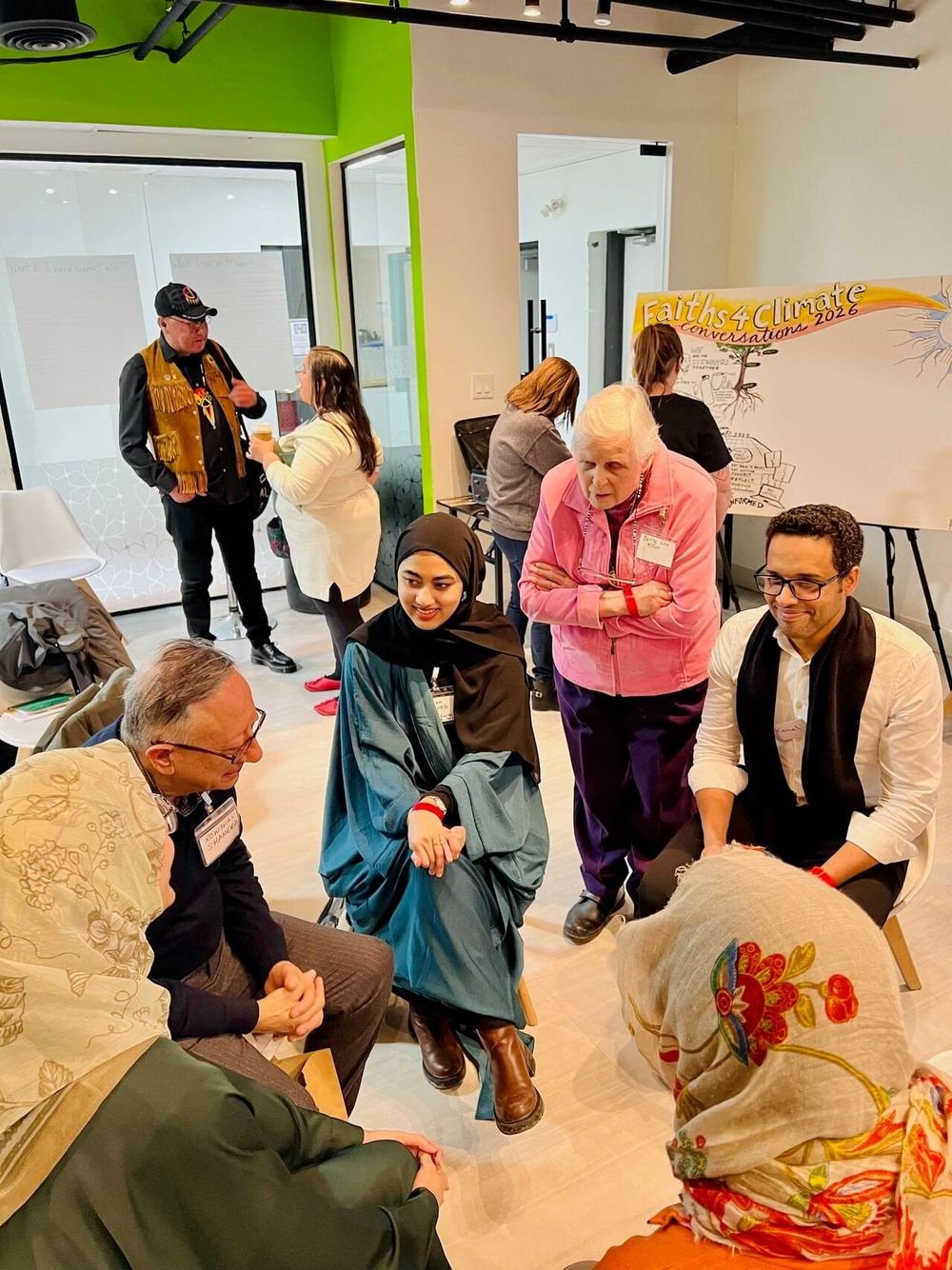
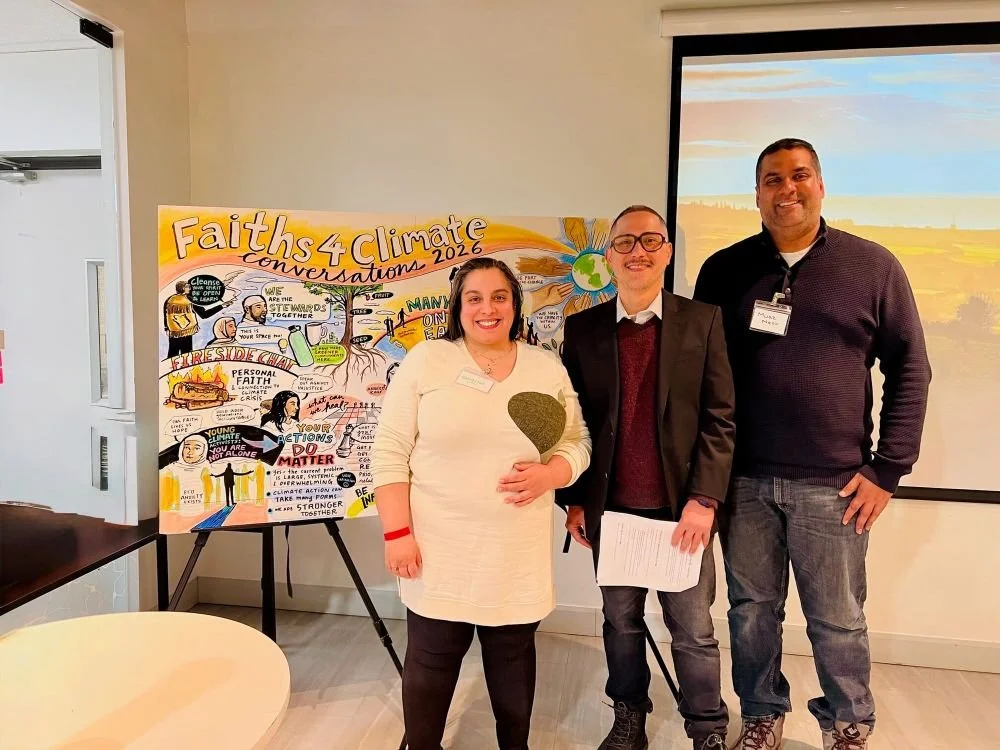
Interfaith Leaders Gather at ISNA Mosque for 2026 Faiths4Climate Conversations

The event brought together a diverse tapestry of spiritual traditions, community activists, and local residents to address the moral and practical imperatives of climate justice and environmental stewardship through an intergenerational lens.

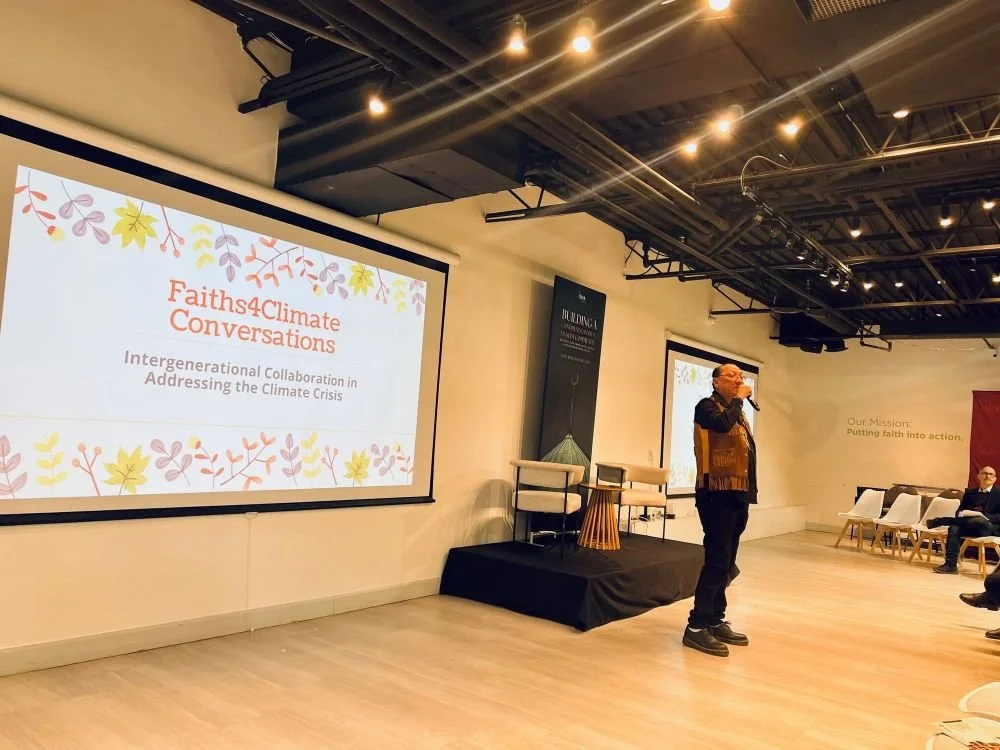
On Sunday, February 8, 2026, the ISNA Canada Centre in Mississauga served as a hub for interfaith environmentalism, hosting the third annual Faiths4Climate Conversations. 

The event brought together a diverse tapestry of spiritual traditions, community activists, and local residents to address the moral and practical imperatives of climate justice and environmental stewardship through an intergenerational lens.

Organized as a collaborative effort involving groups such as EnviroMuslims and Faith & the Common Good, the gathering highlighted the growing momentum of faith-based environmental movements in Canada. 

As the climate crisis intensifies, religious communities are increasingly framing ecological protection not just as a policy issue, but as a profound spiritual duty.

A Shared Moral Ground

The day featured a series of panel discussions, a fireside chat and networking sessions designed to bridge the gap between spiritual teachings and modern sustainability practices. 

Speakers from various backgrounds—including Muslim, Christian, Jewish, Baháʼí, Sikh and Indigenous traditions—shared perspectives on the concept of stewardship.

Participants emphasized that while theological languages differ, the underlying values of protecting the Earth and ensuring justice for vulnerable populations are universal. 

Discussions centred on the idea that faith communities are uniquely positioned to lead on climate issues because of their deep roots in local communities and their ability to mobilize congregations for the common good.

The Role of Youth and Future Generations

The day featured a series of panel discussions, a fireside chat and networking sessions designed to bridge the gap between spiritual teachings and modern sustainability practices. 

Speakers from various backgrounds—including Muslim, Christian, Jewish, Baháʼí, Sikh and Indigenous traditions—shared perspectives on the concept of stewardship.

Participants emphasized that while theological languages differ, the underlying values of protecting the Earth and ensuring justice for vulnerable populations are universal. 

Discussions centred on the idea that faith communities are uniquely positioned to lead on climate issues because of their deep roots in local communities and their ability to mobilize congregations for the common good.

Looking Ahead

The 2026 Faiths4Climate Conversations concluded with a call to action, encouraging attendees to take the lessons learned back to their respective congregations. 

The event was supported by community-building organizations like the Olive Tree Foundation and the Catherine Donnelly Foundation, reflecting a broad institutional commitment to fostering interfaith dialogue around sustainability.

As participants departed, the message was clear: the fight against climate change requires more than just technological solutions—it requires a shift in heart and a collective effort across all lines of faith and culture. 

With the success of this third annual gathering, the Faiths4Climate movement continues to establish itself as a vital voice in Canada’s environmental landscape.

This piece was originally published on IQRA.ca on February 13 2026.

Walking Forward Together: MIC Graduation Marks a New Chapter in Muslim-Indigenous Relations

Imams, Indigenous knowledge keepers, community leaders, and families gathered to celebrate the first in-person graduation of the Muslim-Indigenous Connection (MIC) program. The ceremony marked the completion of a transformative three-month journey for thirteen young Muslim leaders.

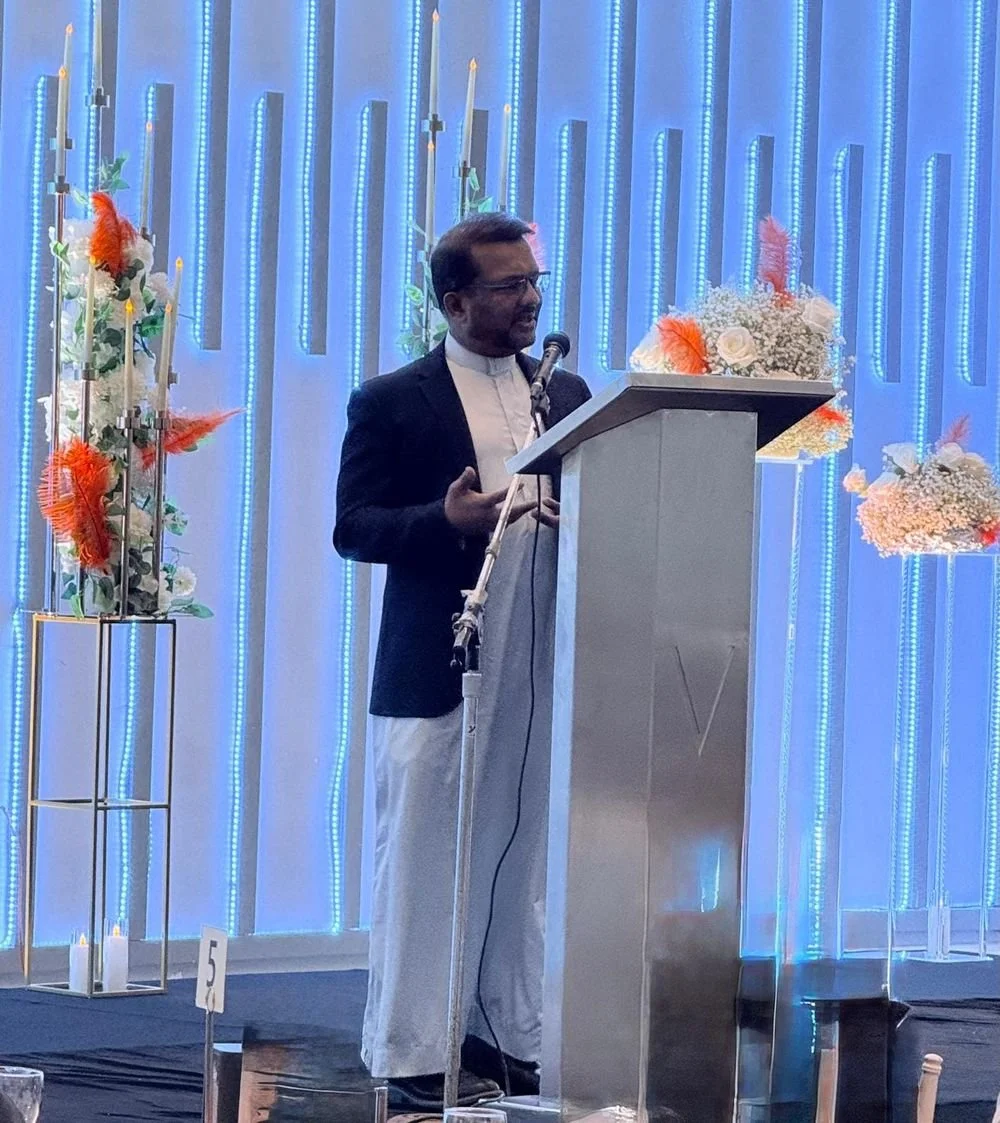
On the evening of Saturday, January 31, 2026, the Verdi Convention Centre was transformed into a space of profound reflection and renewed commitment.

Approximately 80 attendees—including Imams, Indigenous knowledge keepers, community leaders, and families—gathered to celebrate the first in-person graduation of the Muslim-Indigenous Connection (MIC) program.

The ceremony marked the completion of a transformative three-month journey for thirteen young Muslim leaders.

It was not merely a certificate presentation; it was the public unveiling of a national cause that began with a moment of deep spiritual unease.

The Spark: From the Pulpit to Action

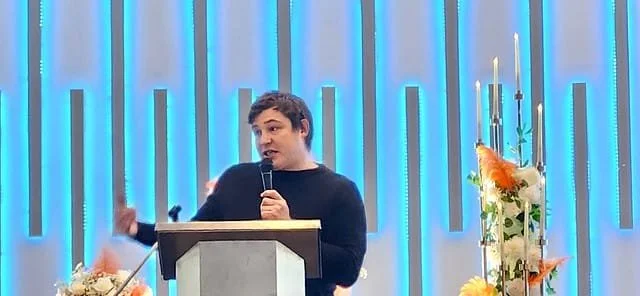
The program’s founder, Imam Irshad Osman, shared the moving story of MIC’s origins.

He traced it back to the summer of 2021, following the discovery of mass graves at the Kamloops residential school.

Standing at the pulpit to read a solidarity statement, Osman found himself haunted by a question of sincerity.

"Was I being sincere? Or was I just reading words?" Osman reflected. "As Muslims, we had been living on Turtle Island... placing our foreheads in Sujood (prostration) on this earth. Yet we had never genuinely learned the history of those who stewarded and protected the earth for us to settle."

This discomfort became the seed for the MIC youth leadership program and the birth of Canadian Muslims in Reconciliation (CMIR)—the first non-profit in Canada focused specifically on building authentic, sustained relationships between Muslim and Indigenous communities.

A Journey Toward Justice

The evening, guided by Emcee Yusra Hassan, featured a diverse array of voices that illustrated the breadth of the program's impact.

After a moving Qur'an recitation by Hafiz Abdullah Sarfraz and a Land Acknowledgment by Hafsa Siddiqui, several guest speakers shared their perspectives on the intersection of faith and reconciliation.

Imam Abd Alfatah Twakkal spoke on the "Journey Towards Justice," while Indigenous Knowledge Keeper Mark Szkoda explored the "Co-existence of Spirituality and Religion."

Mohamed William provided a global perspective, speaking on "Indigenous Solidarity for the Palestinian Struggle," highlighting how the pursuit of justice for Indigenous peoples on Turtle Island is deeply connected to global struggles for human dignity.

MIC Alumna Maryam Sheikh also addressed the gathering, reflecting on how the local work of MIC creates a "global impact" by providing a blueprint for how faith communities can engage in decolonization and healing.

Nasir’s Keynote: Faith as a Bridge

In an address titled "Walking Forward Together," Muneeb Nasir, a pioneer in Muslim-Indigenous relations and board member with CMIR, reminded the graduates that this ceremony was only a beginning.

"You come to this moment not only having completed weeks of learning, but having taken your first steps into a lifelong responsibility," Nasir stated. "Over these weeks, you chose to listen. You chose to learn. And in doing so, you chose relationship."

Nasir emphasized that for the Muslim community in Canada, this relationship is foundational to their identity.

"Our future as Muslims in Canada is inseparable from our relationship with Indigenous peoples," he remarked. "How we belong to this land—how we feel rooted here—is shaped by how we relate to those who have always been here."

He introduced the graduates to the Islamic concept of ‘urf, or local custom, explaining that Indigenous legal orders and treaties represent the ‘urf of Turtle Island.

"Indigenous peoples give us our local customs—‘urf—the living context through which we practice responsibility, dignity, and care in the place we now call home," Nasir explained.

This commitment to knowing one’s neighbours is a divine mandate, as referenced in the Qur’an: “People, We created you all from a single man and a single woman, and made you into races and tribes so that you should recognize one another.” (49:13).

Nasir further highlighted shared values like Amanah (trust), integrity, and the Indigenous teaching of planning for seven generations.

He reminded the audience that "the pain of one is the pain of all, and the honour of one is the honour of all."

A Sacred Pledge of Allyship

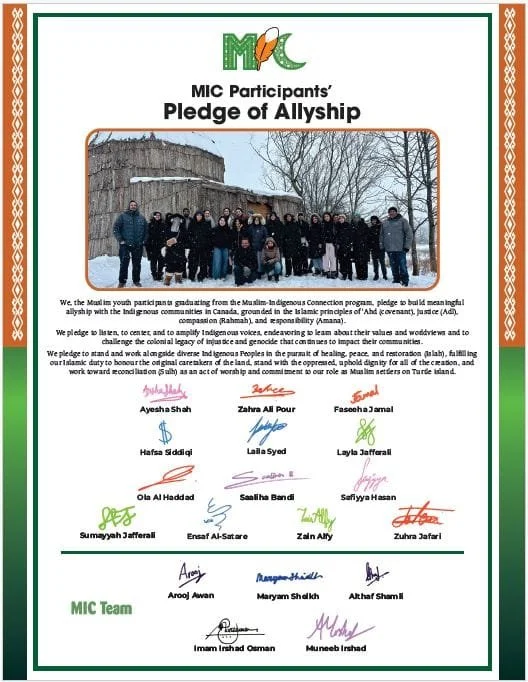
A defining moment of the ceremony, presented by Saaliha Bandi, was the signing of the MIC Participants’ Pledge of Allyship.

Grounded in the principles of ‘Ahd (covenant), ‘Adl (justice), Rahmah (compassion), and Amana (responsibility), the graduates committed to challenging the colonial legacy of injustice and working toward Islah (healing) and Sulh (reconciliation) as an act of worship.

The thirteen graduates who signed this historic pledge are:

Ayesha Shah; Zahra Ali Pour; Faseeha Jamal; Hafsa Siddiqi; Laila Syed; Layla Jafferali; Ola Al Haddad; Saaliha Bandi; Safiyya Hasan; Sumayyah Jafferali; Ensaf Al-Satare; Zain Alfy and Zuhra Jafari.

A Community United in Gratitude

The "Vote of Thanks," delivered by Sumaiya Hidayathullah, recognized the many hands that supported the award-winning program.

Special gratitude was extended to the Indigenous Elders and Knowledge Keepers—including Bevann Fox, Suzie Miller, Mark Szkoda, David Bolton, Brandi Bilodeau, and Julia Kozac—who shared their histories and hearts.

The ceremony also acknowledged the support of numerous partners and sponsors.

As the evening concluded, Muneeb Nasir offered a final call to action, urging the community to choose "respect over comfort, service over silence, and relationship over distance."

He closed with a moving supplication: "Ever present God, You called us to be in relationship with one another.... In our community, we are many different people; we come from many different places, have many different cultures. Open our hearts that we may be bold in finding the riches of inclusion and the treasures of diversity among us."

With the class of 2026 now entering their communities as ambassadors of reconciliation, the seed planted in 2021 has begun to grow into a forest of shared responsibility on this land.

This piece was originally published on IQRA.ca on February 10 2026.

Wholistic Approaches: An Analysis of Islamic And Indigenous Environmental Ethics

By: Ibn Nuruddin

1. Introduction

While many in the past have discussed specific environmental concerns and proposed their fair share of solutions, one may note that many of the suggested solutions are individual fixes. Although the application of these solutions addresses relevant problems, it does not provide a comprehensive mindset that inculcates within society the individual’s role towards and within[1] nature; the kind of perspective that would permeate every facet of their lives and allow them to make responsible decisions which consider the surrounding ecosystem. Hence, I argue that it is necessary for a wholistic solution to environmental crises to consider a reconstruction of society’s anthropocentric capitalistic ethos to a more inclusive communitarian view through an analysis of multiple Indigenous and Islamic ethics, and an exploration of a different economic lens that upholds social gain over individual gain. Appropriating ethical concepts of widening our community to the larger ecosystem, and providing acknowledgement and gratitude towards nature will permit us to respect nature, thus being cognisant when utilizing natural resources.

2. The Twofold Conundrum of Individual Solutions: Potential Risks and a Lack of Structural Change

Mainstream environmentalists battle on specific fronts, and seek remedies for specific problems. The activist battling environmental injustice in a certain region proposes their solution e.g. enhanced and scrutinized supervision of industry factories and their wastes, regulations addressing health concerns for inhabitants nearby, etc., while the environmentalist countering animal agriculture suggests their fix e.g. lowering mass consumption of animal by-products, legal intervention in unethical treatment of animals, etc. In the case of an assumption of success in either scenario, they would merely be solutions for those specific types of environmental concerns. Furthermore, the individual who becomes aware of such an environmental concern would possibly alter some decisions and behavior to address that problem, while being completely unaware of another ecological issue thus making irresponsible choices in that facet. This is demonstrated in many areas of environmentalism; as a passing example, one may bring to recollection the protagonist in “Cowspiracy” where he holds meetings with multiple large environmental organizations that are unaware or reluctant to address the issue of industrial and animal agriculture (Cowspiracy: The Sustainability Secret, 2016). Moreover, some technological solutions have possible detrimental implications. For example, some solutions to managing excess carbon in the atmosphere were suggested. Amidst them is carbon capture and storage, which is the idea of removing carbon from the atmosphere and storing it within the Earth’s layers in porous rock and sand beneath impermeable rock layers that would not allow the carbon to resurface. However, the energy and monetary costs required for carbon storage are significant (The New York Times, 2014). And as intuitive as CCS sounds, the risks of such a solution are unknown. Would the carbon remain underground in the case of a powerful earthquake? Are there other causes that could release it from its subterranean location? In the case of a mass release of carbon from beneath, how disastrous would the effects be? These are merely some questions posed to one of many suggested technologies. Hence, this solidifies the need for a wholistic solution that would not only solve being reactive to environmental crises, but also being proactive to them by adopting ideologies that prevent behaviours causing harm to the environment.

By the same token, employing technical fixes would not aid with the structural changes needed to uproot environmental issues. The inherent nature of capitalism is that it requires never-ending growth for its own survival. As Robbins, Hintz, and Moore state: “… accumulation is necessary to the continued expansion of the capitalist system. The more owners, earn, the more they can put back into production and the more surplus value they can appropriate.” (Robbins, et al., 2013, pp. 104). Such overaccumulation can only exist if there is increased production and industrialization. In turn, increased production leads to overuse of environmental resources. One may observe that the more a nation is successfully capitalist, the more exponentially their carbon emissions rise. Hence, it is unsurprising that developed countries in the Global North like Canada, the United States, and Britain mainly form the 20% that are responsible for 75-80% of historical emissions creating the climate crisis (Klein, 2010, pp. 57). Capitalism is the root cause for the overuse of natural resources creating environmental concerns on multiple fronts. Because the overuse of natural resources is inherently tied to capitalism, it would come to a stop when an alternative inclusive, unselfish, non-anthropocentric economic ethos is appropriated.

3. An Alternative: Structural Changes in Ethos and Ideology

In contrast, when some ethical viewpoints of the Indigenous peoples are analyzed, one can see that interaction and even consumption of nature is done with cognisance, gratefulness, and consideration (Kimmerer, 2013). Thus, an individual adopting such a moral worldview would find it difficult to misuse or overuse natural resources. Similar notions of gratefulness, minimalistic use of resources, consideration of animals and nature in general are inculcated in Islamic ethics. Moreover, both ethical viewpoints offer similar approaches in viewing oneself as a part of the ecosystem rather than different or superior to it.

3.1 A Focus on Communitarianism Vis-A-Vis Humans and The Ecosystem

Capitalism in its intrinsic nature is selfish; it survives by the growth of the self’s accumulation of wealth, leading to industrialism as one needs to industrialize the production of commodities to sell larger quantities. On the contrary, philosophies that prioritize the community promote collective growth, reducing the want for industrialism. Thus, considering humans as one’s own community leads one away from harming nature. A step beyond that is including nature and the entire ecosystem as one’s own community, which is an ethic found in both Indigenous and Islamic ethics.

3.1.1 Community and Interdependence in Indigenous Peoples

The ethical notion of communitarianism is deeply engrained in the Mohawk people. Albeit the Mohawk were composed of different clans, they were unified even in times of difficulty. Upon the death of a clan member, other clans would arrange the funeral ceremony and would take over the duties of the impacted clan provisionally, supporting them through the bereavement (Bonvillain, 1992, pp. 24).  This community-oriented mindset was noted by Europeans. Father Simon Le Moyne in the mid-1650s stated: “No hospitals are needed among them, because there are neither mendicants nor paupers as long as there are any rich people among them… A whole village must be without corn before any individual can be obliged to endure privation” (ibid., pp. 46). Amongst Indigenous peoples, the idea of community extended not merely to other clans and peoples, rather to nature and the ecosystem itself, as can be observed in the Skywoman’s story. When she fell from the sky, the geese flew beneath her to break her fall until she reached the water. The geese could not hold her above the water for long, thus the animals formed a council, and a great turtle offered its back to rest her upon. They soon realized that she would need land to live on, hence the loon, otter, and others endeavoured to dive beneath the water to find land. They worked tirelessly until the muskrat sacrificed its life, drowning in the endeavour but resurfacing with a handful of mud. Thereafter, Skywoman spread the mud on the shell of the turtle and danced thereupon as a thanking gesture towards the animals. The land grew wider and wider as she danced, and thus the Earth was made. “Not by Skywoman alone, but from the alchemy of all the animals’ gifts coupled with her deep gratitude.” (Kimmerer, 2013). This folklore portrays the unity of animals, humans, and nature as it narrates the story of the Earth’s genesis by a concerted effort of all three.

3.1.2 Communitarianism and Economics in Islam: A Response to Capitalism

Communitarianism is an overarching ethic is Islamic tradition. Thus, one is encouraged to always consider others. In an authentic report with an unbroken chain of narrators[2], Muḥammad stated: “A believer is to another believer like an edifice; parts of it solidify other parts.” (Al-Bukhārī, 1997, Ḥadīth 2446). Furthermore, communitarianism is a central ethic in Islamic law (fiqh) in general, but in Islamic financial law especially. “The Islamic economic philosophy underlying Islamic banking and finance prioritises social welfare above individual gains… On this basis, individual satisfaction stems not only from the utilisation of resources for his/her own benefits but also from transferring the resources to others.” (Ibrahim, et. al, 2018). This is evident for anyone acquainted with the Islamic legal corpus and legal theory (uṣūl al-fiqh). Excessive price markups by businesses are prevented by the law against “ghaban fāḥish”, which is excessive profiteering when the item is being sold at an exorbitant price above its cost price (Al-Qudūrī, 2010). Exploitation through risk-free profits is eliminated via legal maxims (qawāʿid fiqhiyyah) such as “al-ghunm bi’l-ghurm”, a legal principle that states that profit-earning is legal only by risk-sharing (Al-Marghīnānī, 2006). Even in marketing, “the Islamic approach emphasizes value-maximization in view of the greater good of the society rather than selfish pursuit of profit maximization” (Saeed, et al., 2001). Marketing ethics are based on empathy towards the Creator’s creations which implies refraining from harming others, thus preventing unethical practices (Niazi, 1996). Hence, a portion of Islamic finance promotes a gift economy through the Qurʾānic doctrines of cooperation (ta‘āwun), partnership (mushārakah), generosity (karam), and communal fraternity (ukhuwwah).

In culmination, one of the biggest structures of exploitation of the poor in capitalism is eliminated by the prohibition of interest-bearing transactions. The nature of interest is to widen the gap between the rich and the poor. As the needy borrows and the rich lends, interest ensures that the needy pays even more for borrowing, becoming poorer, and the rich receives more, becoming richer. Hence in Islamic law, any loan granted with the slightest profit in return is one of the weightiest crimes; one indulging in such a transaction has declared war upon the Creator (Qurʾān 2:279). Rather, encouragement is given towards forgiving loans (Aḥmad, 2001, Ḥadīth 8711). Thus, money cannot generate money in Islamic economics. It is unsurprising therefore that the role of the bank is not to accumulate profits, nor to multiply wealthy clients’ savings. Rather, it is to support entrepreneurship and local development (TEDxTalks, 2014). Its ethical practices make Islamic finance more resilient to economic crises than capitalism (AIMS Education, UK, 2020; University of South Australia, 2013). Alternating from the current exploitative economic structure to an ethical considerate economy would promote wholistic changes in society, leading to the removal of overexploitation of nature.

3.2 The Interconnection of Acknowledgement, Gratitude, and Respect of Nature

In Islam, gratitude is a vital aspect as it is profoundly connected with a sense of respect and one’s cognisance of their place in the universe. Expressing gratitude is necessary both towards the Creator and the creation. Muḥammad says: “He who is not grateful to others is ungrateful to God” (Abū Dāwūd, 2008, Ḥadīth 4811). In the introductory verses of the Qurʾān, gratitude towards the Creator is the primary theme (Qurʾān 1:1-7). Furthermore, throughout the day, one is to acknowledge their usage of natural resources, be grateful for them, and use them in moderate quantities. Acknowledgement, gratitude, and moderate use are interrelated as one preserves that which they value and are grateful for, and gratitude only occurs when acknowledgement exists. Thus, moderation in the use of natural resources is a core tenet in Islamic law; wasting is sacrilegious. “Eat, drink, and do not be wasteful” (Qurʾān 7:31) is stated as legislation by the Creator. Interpreting this passage, the classical legal-hermeneutic scholar al-Qurṭubī (d. 1273) states “A form of wastage is that one consumes after their fill” (Al-Qurṭubī, 2019, 4:141). Alpay, Özdemir, and Demirbas interpret the “eating and drinking” in this verse as all the resources required for the continuation of our lives, not merely food and drink (Alpay, et. al., 2013). Such moderation is also to be observed in water usage. In a historic report, Muḥammad passed by Saʿd while the latter was washing his limbs prior to worship.[3] Seeing his use of water, he remarked: “What is this wastage, Saʿd?” Saʿd asked “Is it wastage [if used] in ritual washing?” He replied in the affirmative, adding; “Even if you are taking from a flowing river” (Aḥmad, 2001, Ḥadīth 7065). Hence, in Islamic ethics, consuming from nature more than one needs is seen as a form of disrespect towards nature and its Creator.

 Likewise, gratitude is an essential ethical notion embedded in Mohawk cultural practices. This is displayed in the Thanksgiving Address, a speech addressed to others at gatherings as a spiritual way of displaying gratitude to all parts of the natural world by recognizing the important status of each part. Every section of it that addresses a part of nature is opened with teyethinonherá:tons or tetsitewanonhwerá:tons meaning “we send him/them our greetings and thanks”. It addresses the waters, plants, vegetables, animals, fish, celestial bodies, the people, and the Creator. The verbiage of the address is eloquent and filled with humility; addressing the fish, it states: “We turn our thoughts to all the Fish life in the water. They were instructed to cleanse and purify the water. They also give themselves to us as food.” The last sentence depicts that the fish are acknowledged, their consumption is recognized, and gratitude is expressed towards them. This is a much humbler ethos and viewpoint than the anthropocentric behavior exhibited in consumption found in mainstream Western society. This humility allows the individual and society to be cognisant when consuming from nature.

The practice of expressing gratitude in both beliefs instills a sense of humility and respect. This allows one to understand that their place in the world is among the creation, coexisting interdependently with the natural world and their fellow inhabitants.

4. Conclusion

In conclusion, our society and infrastructure would benefit from reconstructing the current mainstream anthropocentric capitalistic worldview. Adopting alternative ethical notions from Islamic moral philosophy and Indigenous ethics would aid us to more wholistic approaches to environmentalism inasmuch as it is a proactive solution to change societal behaviour, rather addressing environmental disasters post facto reactively, making it more efficient. As much as technical fixes are relevant, a concerted effort utilizing technical solutions merged with a more inclusive egalitarian ethos between humans and nature would generate structural, thus long-lasting solutions.

Works Cited

Abū Dāwūd. 2008 Sunan Abu Dawud. (N. Al-Khattab, Trans.). Riyadh: Darussalam Publishers and Distributors.

AIMS Education, UK. (2020). Financial Crisis and Islamic Finance – Reasons of Resilience | Aims (Uk). YouTube. https://www.youtube.com/watch?v=7dNAgmWObNI.

Al-Bukhārī. 1997. Sahih al-Bukhari. (M.M. Khan, Trans.). Riyadh: Darussalam Publishers and Distributors.

Alpay, S., Özdemir, I., & Demirbas, D. (2013). Environment and islam. Journal of Economic Cooperation & Development, 34(4), 1-22. http://myaccess.library.utoronto.ca/login?qurl=https%3A%2F%2Fwww.proquest.com%2Fscholarly-journals%2Fenvironment-islam%2Fdocview%2F1518511203%2Fse-2%3Faccountid%3D14771

Al-Qudūrī. 2010. The Mukhtaṣar of al-Qudūrī. (T.M. Kiani, Trans.). London: Ta-Ha Publishers Ltd.

Al-Marghīnānī. Al-Hidāyah: The Guidance. (I.A.K. Nyazee, Trans.). Bristol: Amal Press.

Al-Qurṭubī. 2019. Al-Jāmiʿ li aḥkām al-Qurʾān. Cairo: Dār al-Kutub al-Misriyyah.

Auliawati, N., Prabarayi, L., Damroni, R., & Handajani, J. (2019). Effect of salat (prayer) activity on salivary status and cortisol level. Majalah Kedokteran Gigi Indonesia5(2), 51–54. https://doi.org/10.22146/majkedgiind.36959

Bonvillain, N. (1992). The Mohawk. New York: Chelsea House.

COWSPIRACY. 2016. Cowspiracy: The Sustainability Secret. [online] Available at: http://www.cowspiracy.com/ [Accessed 21 March 2021].

Holy Qur’an. 2001. (A.Y. Ali, Trans. & T. Griffith, Ed.). Woodsworth.

Ibrahim, M., & Alam, N. (2018). Islamic economics and Islamic finance in the world economy. World Economy41(3), 668–673. https://doi.org/10.1111/twec.12506

Kimmerer, R. W. (2013). Braiding sweetgrass. First edition. Minneapolis, Minnesota: Milkweed Editions.

Klein, N. (2010, February). Paying Our Climate Debt. David Lewis Memorial Lecture. Delivered at David Lewis Memorial Lecture, Toronto, Canada.

Mohammad Saeed, Zafar U. Ahmed, & Syeda-Masooda Mukhtar. (2001). International Marketing Ethics from an Islamic Perspective: A Value-Maximization Approach. Journal of Business Ethics32(2), 127–142. https://doi.org/10.1023/A:1010718817155

Niazi, L. (1991). Islamic law of contract. Research Cell, Dyal Sing Trust Library.

Robbins, P., Hintz, J., & Moore, S. A. (2014). Environment and society: A critical introduction. Chichester, West Sussex: John Wiley & Sons.

TEDxTalks. (2014, July 31). The Islamic perspective of banking | Wojciech Gajewski | TEDxWroclaw. YouTube. https://www.youtube.com/watch?v=uPeIesugF14.

The New York Times. (2014, July 23). Carbon Capture Explained | How It Happens [Video]. YouTube. https://youtu.be/kigGiWQw8E8/ Accessed 21 March 2021].

University of South Australia. (2013). The rise of Islamic finance – Knowledge Works. YouTube. YouTube. https://www.youtube.com/watch?v=P_cVuLpD_rs.

[1] One may consider that while the first i.e. the human’s role towards nature (the responsibilities one bears towards the environment while still not viewing oneself as part of it), is very well understood and discussed, the latter i.e. the humans role as a mere part of the larger ecosystem, is less acknowledged. Thus, the notion of “wilderness” was born, perceiving nature either as the “frontier” or the “sublime”. See Cronon, W. (1995). The trouble with wilderness: or, Getting back to the wrong nature. New York: Norton.

[2] This refers to the isnad system for the verification of historic reports. Using the isnad system, one narrates a report mentioning its direct source (whom they heard or transmit from), so forth mentioning each narrator until the earliest narrator to the original source. Each narrator is thereafter evaluated biographically for reliability. For example, when quoting Einstein orally, the authenticity of such a quote using the isnad system would be evaluated by its chain of narrators to the earliest direct source who transmitted it from Einstein, while evaluating each narrator in the chain. This is a genial method that was developed by Muslim historians and traditionists to preserve their tradition. This marks a significant difference in epistemic weight between Islamic sources and other Judaeo-Christian sources. On the epistemic rigour of historical reports using the isnad system in Islamic intellectual tradition especially in the ḥadīth genre, see Siddiqi, M. (1961). Hadith literature: its origin, development, special features and criticism. Calcutta University, and Aʻẓamī, M. (1978). Studies in early Hadīth literature: with a critical edition of some early texts (2nd ed.). American Trust Publication. On the stringency in the ethics of reporting or even resharing tweets in Islam, see Abiya Ahmed. (2018). “Fake News” and “Retweets”: News Reporting and Dissemination Ethics in the Qur’ān. Journal of Islamic and Muslim Studies, 3(2), 61–84. https://doi.org/10.2979/jims.3.2.05.

[3] In Islamic theology, one is required to wash limbs that are commonly used such as the hands, feet, and face prior to worship, a practice known as wuḍū. For the medical benefits of this practice, see Auliawati, N., Prabarayi, L., Damroni, R., & Handajani, J. (2019). Effect of salat (prayer) activity on salivary status and cortisol level. Majalah Kedokteran Gigi Indonesia5(2), 51–54.

This piece was originally published on the Foundation for Inquiry Knowledge, and Revival on December 2 2025.

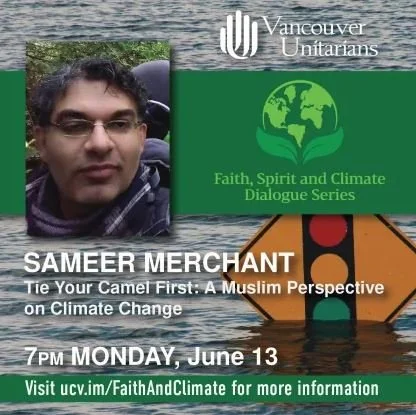
Islam and Climate Change: The Prophetic Cure to Eco-Anxiety

Authored by Dr. Jibran Khokhar

Islam offers a framework for navigating climate anxiety that is both spiritual and practical. It is constituted by an ethical combination of restraint, hope, and solidarity.

A global survey published in The Lancet Planetary Health in 2021 reported that among more than 10,000 young people between the ages of 16 and 25 across multiple countries, sixty percent described themselves as very worried about climate change, and nearly half said their anxiety affects their daily functioning.

 Compared to the threat that climate change poses to our physical health, from heat-related injuries to the spread of tropical diseases, its mental health consequences are far less researched. But emerging studies reveal a mounting toll, especially among young people. Survivors of weather-related disasters report high rates of PTSD, depression, sleep disruption, and learning difficulties. For example, nearly three-quarters of the child and adolescent population in Pakistan experienced learning challenges following the devastating floods of 2010 and again in 2022.

 More recently, communities in North America have also suffered from unprecedented flooding, underscoring the compounding burden of climate-related disasters.

For young people especially, climate anxiety often manifests as panic attacks, insomnia, obsessive thinking, and a pervasive sense of hopelessness. Many feel abandoned by those in power. This younger generation struggles with what experts call the “intergenerational injustice” of inheriting the fallout of choices made by those before them.

Islam offers a framework for navigating this crisis that is both spiritual and practical. It is constituted by an ethical combination of restraint, hope, and solidarity. This approach is much needed in recent times with the rise in climate change denialism. Allah says: “Corruption has appeared on land and sea because of what people’s hands have earned, so He may let them taste part of what they have done, that perhaps they will return” (Qur’an 30:41). This verse speaks implicitly to the current crisis.

 Climate change can be considered a form of corruption born of human excess, and yet denialism persists in the face of mounting evidence. The Qur’an reminds us that such corruption is both a sign and a warning, meant to provoke humanity to change course before further destruction occurs.

Restraint against overconsumption

The Prophet ﷺ told us not to waste water, “even if you were on the bank of an abundantly-flowing river.”

Abundance does not give us license for excess. Even in contexts where resources appear limitless, restraint is part of faith. For those of us living in the wealthier parts of the world, this hadith calls on us to rethink our consumption. Islam teaches that even restraint is an act of worship and entails accountability before Allah.

​​The Qur’an makes this principle explicit in relation to eating and drinking: “O children of Adam, take your adornment at every masjid, and eat and drink, but be not excessive. Indeed, He does not like those who commit excess” (Qur’an 7:31). Similarly, in financial matters Allah says: “Indeed, the wasteful are brothers of the devils, and ever has Satan been to his Lord ungrateful” (Qur’an 17:27). Together, these verses remind us that overconsumption in any form is not simply unwise but spiritually blameworthy.

This framework becomes especially urgent when considering modern food systems. Meat production, for example, has significant environmental impacts. It increases greenhouse gas emissions through methane and carbon dioxide, contributes to deforestation, degrades land used for grazing and feed crops, exhausts freshwater resources, and causes water and air pollution. These impacts highlight how everyday choices, particularly in wealthier societies where meat is consumed in abundance, can disproportionately harm the environment. The call to moderation in food consumption is not only a spiritual safeguard but a practical necessity in preserving creation.

Sayyiduna ʿAli bin Abi Talib (ra) once said: “What is above sufficiency is israf (extravagance).”

 This wisdom shows that restraint is not about deprivation but about recognizing the boundary between need and indulgence. Living within the limits of sufficiency nurtures gratitude, reduces waste, and aligns with the Qur’anic ethic of balance.

It is important to remember that just because something is accessible does not mean it is free of cost. The same restraint that applies to food and water extends to modern technologies. Artificial intelligence, for instance, comes with a significant environmental footprint, requiring vast amounts of energy and water for data centers. This means that every choice to consume more, even digitally, carries consequences. Abundance in access should never make us forget responsibility in stewardship.

Restraint is essential, but it is only an initial step. It is simply the absence of action; how, then, should we actually act?

Planting hope

Perhaps the most powerful Prophetic guidance for our moment of climate despair is the hadith: “If the Hour comes while you have a sapling in your hand, then if you can plant it before it [the Hour] comes, plant it.”

 At first glance, this seems illogical: Why plant a tree when the world is ending? But the Prophet ﷺ was teaching a deeper principle: that believers must never allow fear of futility to immobilize them. Even in the face of ultimate destruction, action rooted in goodness for the sake of Allah retains its value.

This lesson aligns with modern research on climate change anxiety (CCA). A recent mixed-methods study of emerging adults in the United States found that climate anxiety is strongly associated with symptoms of generalized anxiety disorder (GAD) and major depressive disorder (MDD). Yet the study also found that engaging in collective action, working alongside others to address climate change, buffered against the mental health burden of climate anxiety. Individual action, in contrast, often felt insignificant and failed to reduce symptoms.

The Qur’an itself commands this ethic of collective action: “And cooperate in righteousness and piety, but do not cooperate in sin and aggression” (Qur’an 5:2). In the face of climate anxiety, this verse reminds us that strength comes from solidarity. Working together not only amplifies impact but also strengthens hearts, lessening the sense of isolation that fuels despair.

The hadith of the sapling reflects this dynamic perfectly. Planting a tree is not a solitary act. Its benefits are not limited to humans, and could benefit ecosystems and species one might have never considered. It embodies a vision of continuity that extends beyond ourselves, reminding us that what may feel like a small gesture can help restore agency, build community, and provide a counterweight to despair. Planting, in this sense, is both literal and symbolic: we plant acts of goodness whose fruits could be reaped long after we are gone. Importantly, even when the situation seems hopeless (i.e., world-ending), the act itself has weight before Allah; He grows and rewards our efforts, whether in this life or next. 

The Prophet ﷺ emphasized this in another narration: “No Muslim plants a tree or sows a seed and then a bird, or a human, or an animal eats from it but that it is charity for him.”

With this hadith, the Prophet ﷺ shows us that the benefits of a single seed extends in countless directions, becoming a source of charity and reward long after the initial act of planting. The tree continues to testify to the believer’s goodness through every life it sustains, whether human or animal.

The Prophet ﷺ reinforced this ethic when he said: “Do not belittle any act of good, even if it is meeting your brother with a smile.”

 No act is too small to matter. From planting a seed to reducing waste to advocating for climate justice, each contribution done for Allah’s sake is meaningful in Allah’s sight, even if it feels minor in worldly terms.

Stewardship and solidarity

The climate crisis cannot be disentangled from global conflict. Wars amplify environmental destruction through burning fields, demolished infrastructure, poisoned water systems, and mass displacement. This reality deepens the urgency of our advocacy for brothers and sisters in places like Gaza and Sudan, where people face not only the brutality of war but also the compounded devastation of environmental collapse.

It is important to recognize that while these conflicts may appear to occur in faraway lands, their environmental impacts do not respect national borders. The destruction of agricultural land, pollution of water, and release of toxins into the atmosphere all contribute to global ecological harm. This means that complacency is ill advised. To turn away from these crises is to ignore the fact that their consequences reverberate across the planet, worsening the climate anxieties that affect us all.

The believers are cast as caretakers not only of the earth: “It is He who has made you successors upon the earth and raised some of you above others in degrees [of rank] that He may try you through what He has given you” (Qur’an 6:165),

 but also of each other: The Prophet ﷺ says, “The Muslim is the one from whose tongue and hand people are safe, and the believer is the one people trust with their lives and wealth.”

Stewardship over the land and stewardship over human beings are one and the same. Caring for the environment is not only about protecting soil, water, and air, but also about protecting the lives, dignity, and future of those who inhabit the earth. To neglect one is to neglect the other.

The Qur’an further calls us to collective responsibility: “And cooperate in righteousness and piety, but do not cooperate in sin and aggression” (Qur’an 5:2). Solidarity in the face of climate change means linking our concern for environmental stewardship with our commitment to justice for oppressed peoples. By working together for both the earth and its people, we honor the fullness of our role as khulafaʾ: successors and caretakers entrusted with this world.

Prophetic hope in an age of anxiety

Climate anxiety is real, and its effects on young people are profound. Yet the Prophetic tradition gives us both a vocabulary and a roadmap for confronting it: restraint in abundance, hope through action, solidarity in the face of injustice, and trust in Allah’s wisdom. The sapling in our hands may feel small, but it carries the promise of shade, sustenance, and renewal for generations to come. Acting in this spirit is not just an environmental ethic but a spiritual path: one that transforms despair into worship, anxiety into hope, and a sapling into a tree of life.

References

  1. Caroline Hickman et al., “Climate Anxiety in Children and Young People and their Beliefs about Government Responses to Climate Change: A Global Survey,” The Lancet Planetary Health 5, no. 12 (2021): e863–e873, https://doi.org/10.1016/S2542-5196(21)00278-3.

  2. Jaime Saavedra and Lynne Sherburne-Benz, “Pakistan’s Floods are Deepening its Learning Crisis,” World Bank, September 28, 2022, https://blogs.worldbank.org/en/endpovertyinsouthasia/pakistans-floods-are-deepening-its-learning-crisis.

  3. Al-Qurṭubī mentions that one of the meanings of “corruption” is “drought, scarcity of vegetation, and the loss of blessing.” See Tafsīr al-Qurṭubī, https://tafsir.app/qurtubi/30/41.

  4. Musnad Aḥmad, no. 7065, graded ṣaḥīḥ (rigorously authentic) by Aḥmad Shākir.

  5. ʿAbd al-Wāḥid al-Āmidī, Ghurar al-ḥikam wa durar al-kalim, ed. Muṣṭafā al-Dirāyatī, 1st ed. (Maktab al-Iʿlām al-Islāmī, 1987), 359.

  6. Musnad Aḥmad, no. 12902. This narration is ṣaḥīḥ (rigorously authentic) according to al-Arnāʾūṭ.

  7. 7. Sarah E. O. Schwartz et al., “Climate Change Anxiety and Mental Health: Environmental Activism as Buffer,” Current Psychology 42 (2023): 16708–16721, https://doi.org/10.1007/s12144-022-02735-6.

  8. Ṣaḥīḥ al-Bukhārī, no. 2320; Ṣaḥīḥ Muslim, no. 1553.

  9. Ṣaḥīḥ Muslim, no. 2626.

  10. Ibn ʿĀshūr mentions the importance of the stewardship and cultivation of the earth. See al-Taḥrīr wal-tanwīr, https://tafsir.app/ibn-aashoor/33/4.

  11. Sunan al-Nasāʾī, no. 4995.

Dr. Jibran Khokhar was born in Kuwait, where he memorized the Qur'an and received ijazah. He earned a Bachelor’s degree in Life Sciences from Queen's University and a Doctorate in Pharmacology and Toxicology from the University of Toronto, followed by a post-doctoral fellowship in Psychiatry at Dartmouth College. Currently, he is an Associate Professor and Canada Research Chair in Translational Neuropsychopharmacology at Western University, where he studies substance use, severe mental illness, and the effects of drugs of abuse on the developing brain. He also serves as a Khateeb for the London community.

This piece was originally published on Yaqeen Institute on November 4 2025..

Islam and Ecology Intertwined: The Islamic Perspective

In the newly released New Ecozoic Reader No. 9, İbrahim Özdemir’s contribution stands out as a crucial voice in the growing global dialogue on religion and ecology. His essay, titled “Muslim Environmental Thought: Ethical Foundations and Contemporary Relevance,” offers a compelling integration of Islamic theology and ecological ethics—challenging dominant Western-centric environmental narratives and broadening the spiritual framework of the ecological movement.

Published by the Center for Ecozoic Studies and introduced by leading scholars Mary Evelyn Tucker and John Grim, this latest issue is a landmark volume exploring interfaith and interdisciplinary approaches to the climate crisis. Özdemir, a well-respected scholar of Islamic environmentalism and contributor to United Nations climate initiatives, brings essential perspective to a collection largely shaped by Western religious and academic traditions.

At the core of Özdemir’s piece is the assertion that environmental stewardship is not a modern invention but a deeply rooted principle within the Qur’an and Islamic philosophy. Drawing on key verses and prophetic teachings, he frames the Earth as a sacred trust (amanah) given to humanity—not for exploitation, but for care, balance, and justice. Özdemir explains that the Qur’anic concept of mīzān (balance) reflects a profound ecological sensibility that calls for harmony among all beings and systems.

“Human beings are not owners of nature, but rather its stewards,” Özdemir writes. “This trust implies accountability—not only before society, but before God.”

His essay also draws historical links to classical Islamic scholars like Al-Ghazālī and Ibn Khaldūn, who emphasized the interdependence of natural and moral order. Özdemir argues that reclaiming this legacy is not just a religious exercise but a political and ecological imperative—particularly for Muslim-majority countries on the frontlines of climate change.

The timing of Özdemir’s article is especially resonant. As Muslim communities around the world grapple with the twin pressures of environmental degradation and socio-economic instability, his call for a revival of Islamic ecological ethics offers both spiritual depth and policy relevance. His involvement in the drafting of the Islamic Declaration on Global Climate Change in 2015 adds real-world weight to his arguments.

Unlike some theological texts that remain abstract or esoteric, Özdemir’s writing is both accessible and actionable. He emphasizes the importance of integrating ecological values into religious education, community practices, and even policy-making. His message is clear: ecological responsibility is not just a secular or scientific concern—it is a moral obligation grounded in faith.

Within The New Ecozoic Reader, Özdemir’s voice enriches a broader mosaic of contributions from scholars of Christianity, Hinduism, Indigenous traditions, and ecofeminism. Yet his essay uniquely positions Islamic thought not on the margins, but at the heart of the global ecological conversation.

As the climate crisis deepens, Özdemir’s work affirms the vital role of Muslim environmental thought in shaping a more just, compassionate, and sustainable world.

Read the full issue here:
The New Ecozoic Reader No. 9 (PDF)

Palestine and Climate Justice

IN RECENT years, climate justice has moved from the fringes of activism into mainstream environmental discourse. But what does it truly mean? Is it simply another term for environmental justice? While the two are closely linked, they are not the same. Environmental justice typically refers to the fair distribution of environmental benefits and burdens — like access to clean air and water or protection from pollution. It highlights how marginalised communities often suffer the most from environmental degradation.

Climate justice, however, is more specific. It focuses on how the climate crisis — and the global responses to it — affect communities unequally. It recognises that climate change is not just a scientific or environmental problem but a deeply political one, shaped by systems of power and privilege.

This distinction is critical. Communities least responsible for climate change — often in the global south — are the most vulnerable to its impacts: rising sea levels, extreme weather, droughts and displacement. These are not random effects; they reflect entrenched global inequalities, many of which are rooted in colonial histories. Therefore, it is impossible to separate climate justice from broader social justice. From extractive industries on indigenous lands to the oversized carbon footprints of wealthy nations, the climate crisis both reveals and deepens historical injustices.

What about ‘green colonialism’

ONE particularly urgent yet under-discussed concept within the climate justice movement is green colonialism. At first glance, the term may seem contradictory. ‘Green’ often implies goodness, sustainability and ethical action. Yet green colonialism describes the troubling reality of environmental and climate policies being weaponised to displace, exploit or control marginalised communities — especially indigenous and formerly colonised peoples.

Green colonialism can happen in several ways: large-scale renewable energy projects built on indigenous land without consent; conservation laws used to evict local communities under the guise of protecting nature; or carbon offset programmes that claim to reduce emissions but require land grabs from vulnerable populations. While often presented as modern, sustainable solutions, these initiatives frequently replicate the same extractive logic that fuelled colonialism.

Historically, colonial powers justified their conquests by claiming to bring ‘civilisation’ or ‘development’. Today, green colonialism enacts similar logic — only this time, under the banner of ecology. A forest planted over confiscated indigenous land may now be framed as a climate solution, even if it erases communities, knowledge systems and biodiversity in the process.

Palestine: green colonialism in full bloom

NOWHERE is the intersection of climate justice, colonialism and power more glaring than in Palestine. For decades, Palestinians in the West Bank and Gaza have endured systemic land dispossession, environmental degradation, and resource extraction under Israeli occupation. Yet less discussed is how the language and imagery of environmentalism — trees, forests, nature — are used to advance settler-colonial aims.

One striking example is Israel’s use of ‘nature reserves’ and ‘green zones’ in the West Bank. These areas are often off-limits to Palestinians, who are prevented from building homes or cultivating their land. Under the pretence of environmental conservation, the land is effectively seized and later used for the expansion of illegal settlements — settlements that disproportionately consume water and energy.

The recent wildfire, the largest in Israel’s history, starkly illustrates this point. Experts traced the fire’s severity to decades of ecologically unsound afforestation policies. Since the early 20th century, Israel has planted non-native, highly flammable trees — like European pines and eucalyptus — across historic Palestine. These ‘green’ projects, while framed as reforestation, have often targeted the ruins of Palestinian villages, erasing both ecological and cultural landscapes.

According to Visualizing Palestine, over 800,000 Palestinian olive trees have been uprooted since 1967 and replaced by invasive species that threaten local ecosystems. The consequences are both ecological and political. When climate disasters like wildfires occur, they expose the dangers of applying ‘green’ policies rooted in colonial logic. Far from healing the land, these policies intensify environmental risk and injustice.

Green colonialism beyond Palestine

PALESTINE is not the only site of green colonialism. Around the world, indigenous and marginalised communities face similar patterns.

In Australia, Aboriginal and Torres Strait Islander peoples have long been excluded from managing lands they have sustained for millennia. Conservation laws have banned traditional practices like controlled burning, and recent renewable energy projects have moved forward without free, prior and informed consent.

In South Africa, the legacy of apartheid still shapes land ownership and environmental policy. Green colonialism has manifested through eco-tourism and conservation areas that exclude black South Africans from land that was once theirs. The promotion of ‘pristine wilderness’ often erases the fact that these areas were once inhabited, farmed and maintained by local communities. Moreover, mining for so-called ‘green minerals’ — minerals that are critically needed for transition to renewable energy — like lithium or cobalt, often happens in poor, Black communities under exploitative conditions and with little benefit to them.

In Kenya and Tanzania, Maasai communities have been evicted from their land in the name of conservation and safari tourism. In India, forest-dwelling Adivasi tribes have been displaced by carbon offset and tree-planting schemes. In Latin America, indigenous resistance to hydroelectric dams and wind farms — projects backed by international climate funds — has been met with repression.

The pattern clearly tells us something: climate solutions imposed without community input and using the colonial logic can become tools of oppression, not liberation.

Why this matters

IT IS tempting to see green colonialism as a faraway issue. But climate justice is not a niche concern — it touches everyone. If climate policies are built on inequality, they will never be truly sustainable. A just transition requires more than switching to solar panels or reducing emissions. It requires challenging the structures of power that caused the crisis in the first place.

What can we do?

Listen to frontline communities: Indigenous peoples, communities of colour, and those most affected by climate change must lead the conversation. Climate solutions imposed from above often fail because they ignore local realities.

Scrutinise ‘green’ narratives: Not all that is labelled sustainable is ethical. If an electric vehicle depends on child labour and exploitation, is it green? If a forest is planted to erase a population’s history and culture, is it conservation?

Support justice-oriented climate action: This means advocating for land back initiatives, resisting exploitative projects, and backing community-led solutions. It also means demanding accountability from governments and corporations — not just for emissions, but for the impact of their activities on people.

Reclaim agency within our own communities: Each of us has a role to play — in our schools, workplaces, faith spaces, and beyond. Climate action is not only about carbon footprints; it’s about fighting for dignity, equity, and a liveable future for all.

This conversation is especially vital for the global Muslim community. From Palestine to Sudan and Kashmir to Yemen, Muslim-majority regions are disproportionately affected by war, occupation, displacement and environmental harm. Climate justice thus should not be viewed as a Western framework that is alien to our tradition. In fact, it offers language that resonates deeply with Islamic principles such as justice (‘adl), stewardship (khilafah), and dignity (karamah).

We must reject the role of passive recipients of ‘green aid’ or targets of environmental blame. It is time that Muslim thinkers, scholars and youth should develop frameworks rooted in Islamic ethics, environmental care, and social justice — frameworks that speak back to both climate inaction and climate imperialism. We are not outsiders to this conversation. In many ways, we are its heart.

Raudah M Yunus is a researcher, writer and activist from Kuala Lumpur, Malaysia. She is currently pursuing a postdoctoral fellowship in the United States.

The article was originally posted on New Age

Jami Peace Garden: A ​new ​green ​space ​blooms in West Toronto

The Jami Mosque at 56 Boustead Avenue buzzed with activity ​o​n Saturday, May 24, as neighbours and community members gathered to plant the new Jami Peace Garden. From 9:30 AM to 12:30 PM, volunteers dedicated themselves to transforming a portion of the mosque grounds into a vibrant green space, fostering a sense of community and connection to nature.

The call to action for the planting day was widely shared, inviting everyone to participate in "a morning of community, fun, and sadaqah jariyah!" (a continuous charity). The organizers ensured that "plants and gardening tools" were provided, welcoming all, regardless of gardening experience. Light refreshments were also served, adding to the communal atmosphere.

This​ project is a testament to the power of collective effort, with the Jami Mosque expressing gratitude for the turnout. "This morning, neighbours and community members came together to launch this beautiful project — sharing their love for the environment and beautifying the iconic Jami Mosque in the heart of Toronto," a social media post stated, acknowledging the enthusiastic participation. A special thank you was also extended to the mosque's "dedicated Green Team of volunteers and everyone who came out to support!"

The Jami Peace Garden project is supported by the City of Toronto’s Pollinate TO program. This vital backing underscores a shared commitment to enhancing urban biodiversity and creating more green spaces that benefit both residents and local ecosystems. The garden is specifically designed to feature plants beneficial to pollinators, further contributing to Toronto's ecological health.

This piece was originally published on IQRA.ca on May 24 2025..

How Islam Encourages Responsible Waste Management on Eid ul-Adha

Eid Ul Adha is a sacred day where the Muslims perform their Sunnah and sacrifice animals in the name of Allah. The day commemorates the devotion of Prophet Ibrahim (A.S.) to Allah. The day helps us to withhold the traditions of Islam. At the same, it also brings along specific practical responsibilities as well particularly around the management of waste. Our Holy Prophet has repeatedly talked about cleanliness and hygiene. Therefore, our Muslims must act upon Sunnah and maintain a clean environment during this important occasion.

Protection of the Environment

Islam often calls Humans as Protectors or Khalifah of the Earth. Every human is responsible for protecting the environment and managing the waste accordingly. It means that we should not waste excessively and avoid producing waste. We must also ensure that waste management practices are utilized thoroughly and responsibly. All of these teachings become even more relevant when the Muslims sacrifice animals during Eid Ul Adha.

Tips to Manage Waste During Eid Ul Adha

Here are a few tips that can help you manage waste during Eid Ul Adha:

1.     Disposal of Animal Remains

Eid Ul Adha is celebrated all over the world by the Muslims. It is the day when Muslim sacrifice animals and perform the Sunnah of Ibrahim (AS). You can learn more about the importance of this important occasion from here. 

Islamic tradition promotes cleanliness as a part of faith. After you sacrifice, it is essential to dispose of the remains of the animal. Proper disposal of these remains helps to prevent pollution and reduce health risks. In most Muslim majorities, the local authorities provide a designated area where you can perform the sacrifices and dispose of the waste afterward. Muslims must follow the guidelines provided by their local authorities to ensure they maintain a hygienic environment.

2.     Share the Sacrificial Meat

Muslims must distribute the meat of the sacrificial animal. As per Islamic traditions, the meat must be divided into three portions: family, friends, and the needy or the poor people. Proper and wise distribution of the meat helps to keep the waste minimal.

3.     Avoid Sacrificing Animals

Islam does not promote any excessive practices, which include excessive sacrifice. We must always perform the sacrifices in moderation that align with our financial condition. Over-sacrificing means that there will be extra wastage that will be difficult to manage. Going against these practices helps to maintain a balance in environmental waste.

4.     Use Sustainable Practices During the Sacrifice

In recent years, Eco-Eid is a new concept that is gaining traction. It involves sustainable practices such as using biodegradable bags to collect waste and avoiding plastic packaging. These biodegradable practices align with Islamic values and reduce harm to the environment.

Conclusion

Eid Ul Adha is a special occasion for reflection and giving. It also serves as an opportunity for all Muslims to become the protectors of the environment. Following the teachings of Islam in moderation helps to maintain cleanliness.

Rafia is a certified Quran scholar and Islamic content writer based in Pakistan. She is passionate about educating and inspiring others through her writing, promoting a deeper understanding of Islamic principles. She occasionally writes articles for Muslim And Quran.

Government Funding for Warming Centres at Islamic Centres

Provincial funding will help create new community warming centres and lower power bills at mosques in Truro and Dartmouth.

The Province also announced funding today, April 22, to help create new community transit options for the people of Truro and the Municipality of the County of Colchester.

“I am pleased to announce this funding that will benefit people throughout Colchester and Truro, while also helping reduce the province’s greenhouse gas emissions and create more clean, renewable energy to power important community places,” said Dave Ritcey, Minister of Communities, Culture, Tourism and Heritage and MLA for Truro-Bible Hill-Millbrook-Salmon River, on behalf of Timothy Halman, Minister of Environment and Climate Change. “This type of community-led leadership is inspiring to all Nova Scotians and demonstrates the kind of action we need to create stronger and more caring communities and fight climate change.”

The Islamic Association of Nova Scotia received $116,691 from the Sustainable Communities Challenge Fund for solar panels, generators and building upgrades to their Truro and Dartmouth mosques. These upgrades will lower their energy bills, reduce greenhouse gas emissions and allow the facilities to be used as public warming centres during extreme weather events.

The Municipality of the County of Colchester and the Town of Truro received $102,800 from the fund to explore options for a regional public transit network that will be green, sustainable, accessible and affordable transportation options.

Quotes:

“The Nova Scotia Federation of Municipalities is pleased to support the Islamic Association of Nova Scotia and the Municipality of the County of Colchester through the Sustainable Communities Challenge Fund. The association’s energy modernization project will significantly reduce its carbon footprint, while Colchester’s project will provide valuable insights into energy consumption to support a regional public transit network. These projects are great examples of how communities can take meaningful action on climate change while lowering energy costs and enhancing long-term sustainability.”
Juanita Spencer, CEO, Nova Scotia Federation of Municipalities

“With the support of the Province of Nova Scotia, the Islamic Association of Nova Scotia is making important upgrades to become more energy efficient and environmentally friendly. These improvements – like installing solar panels, battery backup systems and making our facilities more efficient – will help us meet the growing needs of the Nova Scotia Muslim community in a sustainable way. As our community continues to grow through immigration and migration from other provinces, we need long-term, cost-effective solutions to support religious and social services. The savings from these upgrades will allow us to reinvest in our community and support local businesses. As a volunteer-run non-profit, this progress would not be possible without provincial support, and we are deeply grateful for it.”
Emad Aziz, community outreach officer, Islamic Association of Nova Scotia

“We are excited to embark on this important initiative with the Municipality of Colchester. This plan is critical to understanding the needs of our community and how best we can create a transit system that works for everyone. Together, we can develop a plan that not only improves transportation but also contributes to a more sustainable and equitable future.”
Cathy Hinton, Mayor, Town of Truro

“We believe this study represents a significant opportunity to enhance transportation in our region, reduce environmental impact and improve accessibility for all.”
Christine Blair, Mayor, Municipality of the County of Colchester

Quick Facts:

  • the government created the Sustainable Communities Challenge Fund in 2021 as part of the Environmental Goals and Climate Change Reduction Act, its legislated commitment to reduce greenhouse gas emissions, respond to climate change, transform how Nova Scotians produce and use energy, make homes and buildings energy efficient, and more

  • the program provides grants to municipalities, non-profit and community organizations, post-secondary institutions and Mi’kmaw communities to help them respond to and prepare for climate change impacts, and to reduce greenhouse gas emissions

  • the Nova Scotia Federation of Municipalities was selected through a request for proposals process to develop and administer the Sustainable Communities Challenge Fund on behalf of the government

  • since launching in 2022, about $10 million has been invested through the fund

  • the Province’s accessibility strategy, Access by Design 2030, outlines how the government will achieve its goal of an accessible province by providing people with disabilities equitable access to programs, services, information and infrastructure

Additional Resources:

More information on the Sustainable Communities Challenge Fund is available at: https://nschallengefund.ca/

News releases about the fund and related projects: https://news.novascotia.ca/search/all?field_topics=228

Environmental Goals and Climate Change Reduction Act: https://nslegislature.ca/sites/default/files/legc/statutes/environmental%20goals%20and%20climate%20change%20reduction.pdf

Our Climate, Our Future: Nova Scotia’s Climate Change Plan for Clean Growth: https://climatechange.novascotia.ca/sites/default/files/uploads/ns-climate-change-plan.pdf

Weathering What’s Ahead: Climate Change Risk and Nova Scotia’s Well-being: https://climatechange.novascotia.ca/climate-impacts

Greenpeace's "EDUCATE Renewable Energy Toolkit" is a comprehensive guide designed to assist Islamic financial institutions in integrating renewable energy initiatives within the framework of Shariah principles. Developed by Greenpeace MENA in collaboration with Ummah for Earth and the Global Ethical Finance Initiative, this toolkit offers a structured approach to fostering sustainable energy practices.

The toolkit introduces the EDUCATE framework, encompassing six key components:

  • Engage: Encouraging proactive involvement with the renewable energy sector.

  • Develop: Creating sustainability frameworks that align with Islamic finance principles.

  • Utilize: Implementing innovative renewable energy products.

  • Capacity: Building expertise in renewable energy project evaluation.

  • Align: Setting renewable energy financing targets.

  • Track: Monitoring and reporting progress.

  • Exchange: Participating in sustainable finance initiatives and sharing best practices.

Each section provides actionable strategies, case studies, and resources to facilitate the adoption of renewable energy solutions. The toolkit emphasizes the importance of aligning financial practices with ethical and environmental standards, highlighting the potential for Islamic finance to play a pivotal role in the global transition to sustainable energy.

By offering a faith-based perspective on environmental stewardship, the toolkit aims to inspire Islamic financial institutions to contribute actively to climate action, promoting a balance between economic development and environmental responsibility.

For more detailed information, the full toolkit is available here: EDUCATE Renewable Energy Toolkit.

Environmental Stewardship and Muslim Engagement in Canada

Environmental issues may serve as a platform for interactions between people from diverse religious and nonreligious backgrounds. I explore how individuals collaborate, navigate challenges, bridge differences, and work towards solutions in the context of environmental concerns. Islam, like many other religious traditions, encompasses worldviews and guiding principles related to the environment and nonhuman animals. This exploration focuses on whether Muslim engagement with environmental issues is driven by religious principles, or by factors beyond religion.

Hinna Hussain is a PhD candidate in the Department of Classics and Religious Studies, University of Ottawa. Her doctoral research explores the role of environmental issues in fostering interaction and engagement between Muslims and individuals from diverse backgrounds.

Prayer rug celebrating ties between Indigenous and Muslim peoples adorns new Eid stamp

Canada Post is proud to mark two festivals celebrated by Muslim Canadians with a stamp featuring the Canadian Prayer Rug

OTTAWA, ON, March 10, 2025 /CNW/ - Canada Post issued a new stamp today to mark two of the most important religious holidays in Islam: Eid al-Fitr and Eid al-Adha. The commemorative stamp features a prayer rug celebrating the connection between Indigenous and Muslim peoples – and the multi-faith collaboration that built Canada's first mosque.

The Canadian Prayer Rug was created in 2016 as a project of The Green Room, a youth-support program run by the Edmonton-based charity IslamicFamily, which provides spiritually and culturally sensitive services to the local community.

The rug was designed by local Métis artist Kit Craven and Muslim weaver Noor Iqbal, based on research and interviews carried out by youth with Indigenous Elders and descendants of early Muslim settlers.

Prayer rug commemorates relationship that resulted in Canada's first mosque

The rug's design depicts Alberta's diverse landscapes and distinct seasons. At its centre are an archway and a lodgepole pine – a tree that supports teepees and lodges and is reminiscent of the cypress of settler homelands.

Weaved with locally sourced wool, dyes and other materials, the prayer rug reflects the rich cultural and geographical history of the region, bringing together elements that honour the community's heritage.

More than a work of art, the rug symbolizes unity and multiculturalism within Treaty 6 Territory, which includes Edmonton. It celebrates the deep, enduring connection between Indigenous and Muslim communities, which helped to open the country's first mosque in Edmonton in 1938.

Celebrating Canada's culturally diverse population

This is Canada Post's seventh stamp issue commemorating the Islamic holidays of Eid al-Fitr and Eid al-Adha. Celebrated by Muslim Canadians, both events can last several days and include communal prayers and feasts, visits with family, gift-giving and acts of charity.

The Eid stamp is one of several stamps Canada Post issues each year to mark annual celebrations that are important to Canada's culturally diverse population – others include Diwali, Hanukkah and Christmas.

About the stamp

The stamp issue was designed by Kristine Do with illustration by Kit Craven and photography by Maya Visnyei. Printed by Colour Innovations, the issue includes booklets of six Permanent™ domestic rate stamps and an Official First Day Cover cancelled in Edmonton, Alberta.

Eco-anxiety, burnout and loneliness: Why sustainability work takes a personal toll

Climate Change Coaches Heather Lynch, Katherine Ellsworth-Krebs & Shona Russell explore the impact which working in the sustainability profession can take on personal wellbeing – and give advice on thriving in these careers.

If you asked sustainability professionals why they do what they do, most would speak to their commitment of driving positive change and creating a better future for all living beings.

Sustainability professionals aren’t just working to pay the bills – they’re working to create the best chances of a liveable future for us all.

Yet, despite their commitment, many face significant personal challenges.

This year, we surveyed more than 90 sustainability professionals and conducted in-depth interviews with 28. We asked about the day-to-day realities of working in these roles: their challenges, most important skills and what support would make the biggest impact on their ability to transform organizations and society.

What emerged was clear: the biggest challenges that sustainability professionals face couldn’t be solved with more knowledge or technical skills.

Instead, we found that softer skills were most important for sustainability professionals to develop: learning communication, influencing and persuasion skills and self-motivation, persistence and resilience, were what was needed for them to overcome their main challenges and be more capable of working towards a sustainable future.

Eco-anxiety, burnout and greenwashing worries

Eco-anxiety—grief, fear, and worry about the state of the planet—came up in most of our interviews. Sustainability professionals have a huge amount of knowledge about the climate and ecological crises and, as part of their job, are constantly exposed to information about food insecurity, natural disasters, biodiversity losses and other consequences of climate change.

One interviewee said: “Climate change always has this really heavy, serious weight about it…so thinking about that all the time. I think whether I realise it consciously or not, is something that definitely impacts me”.

These constant existential emotions and fears can make it hard to switch off.

Many of our interviewees feel isolated, often being the only one working on sustainability in their organisation, surrounded by people who don’t share their level of concern for the climate and ecological crises.

Without supportive communities or colleagues, this loneliness deepens the emotional toll, exacerbating eco-anxiety and in some cases leading to burnout and people leaving their roles.

Sustainability professionals are expected to be champions and motivators, at the same time as being accountability holders and challengers for their colleagues.

They’re tasked with driving large-scale change but often lack the resources, authority, or senior buy-in needed to make it happen.

In this way, sustainability professionals find themselves having to cajole colleagues to act without any direct line management or KPIs to underpin their requests. From our survey, 37% felt like their goals were always superseded by business interests and 22% said they felt burnt out by the challenges.

Participants shared they felt like sustainability was “all on them” and they are “the only one who cares”.

When we asked participants if their organisations were responding sufficiently to social and environmental challenges, 76% said “no” or “sort of.”

Many sustainability professionals worried they were contributing to greenwashing in the sense that their organisation, at times, made grand sustainability commitments but wouldn’t follow through and give sustainability professionals the support and the resources internally to make these changes happen.

For example, one participant from an environmentally-focused B-Corp said, that leadership “spent more time in the boardroom talking about branding colours than about sustainability”.

Yet sustainability cannot sit only on the shoulders of a small sustainability team or one sustainability professional in an organisation.

Supporting sustainability professionals to thrive

Systemic challenges like climate change require collective responses and there are opportunities for organisations and professional bodies to support the development of soft skills related to self-motivation, persistence and resilience that sustainability professionals said were essential.

For example, in our survey, 50% of sustainability professionals were keen for group coaching specific to this role, 34% wanted more regular engagement with sustainability professional peer networks and 27% desired 1:1 sessions with a coach or therapist to improve their efficacy at work.

Sustainability professionals are integral to the transformation of businesses and organisations to create a better future for everyone. Their resilience, mental health and well-being is essential for them to continue this critical work.

Here are three ways to support sustainability professionals and those working in the sector to increase the likelihood of achieving systemic transformations:

  • Organisations and line managers: Offer professional development budgets for coaching, therapy, or access to peer networks for your sustainability staff. Or, if you only have one sustainability staff member, hire another (even part time). From our interviews it was clear that having more than one person in an organisation concerned about climate and social justice made a world of difference for motivation and momentum.

  • Sustainability professionals, know you’re not alone! There are hundreds of thousands of people around the world working in organisations on sustainability, you can find solace in LinkedIn networks, national conferences and peer-support groups. Don’t think this is all on you, find some peers and you’ll discover others who completely ‘get’ the complexities and challenges you’re grappling with and you can learn from and support each other.

  • Everyone, ask someone else how the climate crisis makes them feel. If we all made a little more room to talk about what it’s like when you see unprecedented weather events in the news or realise that the next generation may not have the same opportunities you experienced, it takes a weight off those tasked with responsibility for sustainability to hold space for others to process their climate grief and anxiety. We can all contribute to creating a psychologically safe and more open, honest and transparent working environment where we take collective responsibility and respond appropriately to the crises we are faced with.

This piece was originally published on edie on November 27th 2024.

There is no climate justice without Palestinian liberation

Written by Abeer Butmeh from PENGON, Friends of the Earth Palestine*

If the international community is serious about climate justice, it can no longer turn a blind eye to its own hypocrisy and the genocide in Gaza.

The world is witnessing a genocide taking place on screens, and live on social media from Gaza and the West Bank. The death toll is over 43,000 human lives – at least 56% of deaths have been of women and children.

We are shown irreversible devastation wreaked on Palestine at the hands of Israel, but the ties between the violations of international and human rights laws and militarisation are ignored. While these crimes also connect to climate change, adding ecocide to the genocide, no mention of them was visible on the global climate stage, COP29. Why?

The overwhelming human and environmental devastation of Gaza should have been made central at this year’s UNFCCC climate negotiations, to bring about climate justice and put an end to what is absolute impunity. How is it that international climate policy ignores this reality, putting so little value on Palestinian lives, humanity and dignity?

The destruction of Gaza is one of the largest cases of ecocide in recent history

This is part of a continuum that started in 1967 with the occupation and theft of Palestinian land for a colonial regime, while the Gaza Strip has been subjected to an arbitrary and illegal 17-year-long blockade. The current war creates environmental destruction that makes Gaza one of the worst ecocides in recent history.

Since the start of the ecocide, the region has undergone extensive damage to soil, water wells, critical solar energy projects and farms. Since October 2023, over 60% of Gaza’s agricultural land has been devastated or destroyed.

The war has spewed hundreds of thousands of tonnes of CO₂, equivalent to burning 31 million tonnes of coal—the output of nearly 16 U.S. coal-fired power plants running for a full year. In just 120 days, this carbon footprint outpaced the yearly emissions of 26 individual countries and territories. Rebuilding Gaza’s shattered urban landscape will drive emissions even higher, exceeding those of the 130 lowest-emitting nations. Meanwhile, the unlawful use of weapons like white phosphorus fills the air and pollutes the soil with toxic chemicals, compounding the environmental destruction.

Gaza was rendered increasingly dependent on renewable energy sources like solar power, with solar energy projects covering 20% of the area’s household energy needs. Israel has committed itself to decimating critical infrastructure, cutting off a lifeline for Palestinians. This also resulted in the cessation or obstruction of desalination plant operations and wastewater treatment plants. Effects are especially profound for women and girls whose lives and health, as a result of the cascading implications, are threatened due to lack of access to proper sanitation and emergency care. Gender justice is central to the fight for climate justice and the liberation of the people of Palestine.

Shameless peacewashing and greenwashing at COP29

The COP29 was just recently hosted by Azerbaijan, proclaiming the negotiations the “COP of peace” while pressing on as Israel’s leading oil supplier.

In a flagrant attempt to both greenwash and peacewash its global image, Azerbaijan hosts global climate negotiations while accounting for approximately 40% of Israel’s annual crude oil imports that are transported through the BTC pipeline, majority owned by BP and state-owned company SOCAR.

The complicity of Global North governments in Israel’s crimes illustrates what many frontline communities in the Global South go through in terms of climate violence. Peoples and lands are sacrificed to protect the profits of powerful elites and big corporations. It is now more important than ever for climate policy to reflect the exceedingly strong ties between climate change, corporate impunity and colonialism. We demand a ceasefire now, an end to the genocide and a free Palestine. There is no climate justice without Palestinian liberation.

* PENGON / Friends of the Earth Palestine is a member group of Friends of the Earth International (FoEI), an environmental and social justice movement. Founded in 1970, FoEI is the largest grassroots ecologist federation in the world and being dedicated to peace, condemns islamophobia and antisemitism, as well as all forms of racism, militarism, oppression and violence.

Image: At COP29, Abeer Butmeh and fellow activists read aloud thousands of names of Palestinian people killed by the genocide in Gaza. Credit: Bianka Csenki, The Artivist Network

This piece was originally published on Friends of the Earth International on November 28th 2024.

This group is breaking down barriers to nature for Muslim students — one classroom at a time

Aim is help students make connections between sustainable habits and their cultural values.

A group of students note observations during a field trip to Dundas Valley Conservation Area in Hamilton. The trip was made possible by Green Ummah, a non-profit geared to creating an environmental movement within the Canadian Muslim community. (Studio Fadeelah)

A non-profit geared to creating an environmental movement within the Canadian Muslim community has taken its work inside the classroom. The aim is to help students make connections between sustainable habits and their cultural values.

Aadil Nathani, co-founder of Green Ummah — ummah means community in Arabic — said the group was created to help address under-representation in environmental causes among Muslim people as well as other racialized groups.

The organization worked with teachers and the environmental organization Nature Canada to develop a two-week curriculum program taught in both private Islamic school settings and public schools in communities with higher rates of racialized and newcomer Canadians. It's called the Greening Our Communities toolkit. 

Nathani told Laura Lynch, host of CBC Radio's What on Earth, he believes the program is the only one in the world with ready-to-teach packages designed for teachers to engage their students on the topics of Islam and the environment, as well as environmental justice.

"We see these students as the future leaders in the world," said Nathani, who also acts as the group's director of operations and partnerships, and is a lawyer for a Toronto firm by day.

"If we can teach them about their role and responsibility in the environment early, the hope is that when they get into these positions of power later on, they will remember their teachings and act in a more careful and meticulous manner than a lot of folks have been doing for the past hundred-plus years." 

Costs for the outing were covered by Nature Canada. School trips like this often carry a fee that can put them out of reach, especially at schools with high numbers of racialized and newcomer Canadians, said Aadil Nathani, Green Ummah's co-founder. (Studio Fadeelah)

Costs for the outing were covered by Nature Canada. School trips like this often carry a fee that can put them out of reach, especially at schools with high numbers of racialized and newcomer Canadians, said Aadil Nathani, Green Ummah's co-founder. (Studio Fadeelah)

He said Muslim communities in Canada have had limited capacity to get involved with environmental movements — and for good reason.

"I've grown up in a post-9/11 world where a lot of the concerns for the Muslim community have been, first and foremost, safety and security within Canada, within the United States," Nathani said, who resides in Scarborough, Ont, a Toronto suburb. 

He points to tragedies in recent years when Islamophobia has erupted in deadly violence, such as the London, Ont., truck attack by Nathaniel Veltman, who killed four members of the Afzaal family in 2021, and the mosque shooting by Alexandre Bissonnette, who killed six people in 2017.

So far, the curriculum program has been run in Ontario high schools and workshopped at the middle-school level. But Nathani says the group's mandate is national, with online resources such as its Green Ramadan program available to anyone in Canada. The group is also hosting events in Alberta and B.C., including one happening this month with the non-profit NatureKids B.C.

Aadil Nathani is the co-founder and director of operations and partnerships for Green Ummah. (Submitted by Aadil Nathani)

Breaking down barriers to outdoor spaces

Nathani says the "coolest part" about the school-based program is the organization's partnership with Nature Canada, which bills itself as one of the oldest national nature conservation charities in Canada.

Funding from that group's NatureHood program has paid to send students on field trips to national wildlife areas, migratory bird sanctuaries or urban nature sites, such as Rouge National Urban Park in Toronto's east end, he said. 

"This has been really unique for us because we also know that newcomer and racialized Canadians face barriers to accessing nature in Canada," said Nathani.

"So we've been able to break those barriers down entirely and actually just send students to do activities in nature spaces, which is great because it builds that connection to the environment and will hopefully lead to the students becoming environmental stewards in the future."

A student from Windsor Islamic High School offers a bowl of seeds to some geese on a field trip to Jack Miner Migratory Bird Sanctuary in Kingsville, Ont., about 45 kilometres outside of Windsor. (Submitted by Green Ummah)

Yavar Mirza, a Grade 11 student from Gibraltar Leadership Academy, an Islamic private school in Toronto, said the two-week program changed the way he views the environment.

"I began to see the natural world not just as, like, a resource for us, but something that is sacred," he said. "It made me realize that climate change is not just a scientific issue. It's a spiritual and moral responsibility that we all have together." 

Mirza says, moving forward, he's committed to upholding the principles that he learned, such as "khilafah, which is basically a stewardship, and amana, which is like a trust that we have to protect the earth." For one thing, Mirza said he plans to be more conscious of his environmental impact by making sustainable choices.

"I would also want to focus on climate justice, especially advocating for solutions that support Indigenous communities and others that are affected by climate change."

Beyond doom and gloom

Nathani says the program was designed to address the problem of students hearing "so much doom and gloom," leading to environmental and climate anxiety. 

"We wanted to let them feel like, yes, there are problems, but we can all collectively be part of the solution," he said.

Anees Chugtai, also in Grade 11 at Gibraltar, said that came through loud and clear.

"The program made me feel a lot more hopeful about humanity's rebuttal against climate change," he said.

"Before the program, I always thought, you know, that the world was just going downhill [and] that we weren't doing anything."

Lilian Tu, a teacher and science department head at Milliken Mills High School in Markham, Ont., said being able to access funds for field trips in nature has been a boon for students at the school. (Submitted by Lilian Tu)

Lilian Tu, a science teacher and department head at Milliken Mills High School in Markham, Ont., said the school has tapped into Green Ummah's curriculum and outdoor education resources for a couple of years.

She said the school is in one of York Region's lowest-income neighbourhoods, which sometimes means participation in field trips — which often carry a fee paid for by families — is out of reach. She said Green Ummah was able to fund "an amazing field trip at an outdoor centre," which was a first for many of her students.  

Then last semester, Green Ummah funded a tree planting outing facilitated by Friends of the Rouge Watershed in Toronto's east end. Tu said many of the students weren't aware that this natural area was so nearby, and that it was empowering for them to learn that by planting a couple of trees, they could be capturing a lifetime of carbon for a family.

"So these kids made a significant contribution [through] this one-day field trip."

But the other great thing to see was the kids just having a good time together outside.

"They're creating spaces for trees to grow and making a huge difference, but they're also just playing as well."

Brandie Weikle is a writer and editor for CBC Radio based in Toronto. She joined CBC in 2016 after a long tenure as a magazine and newspaper editor. Brandie covers a range of subjects but has special interests in health, family and the workplace. You can reach her at brandie.weikle@cbc.ca.

This piece was originally published on CBC Radio - What on Earth on October 6th 2024.

Could religion provide answers for climate anxiety?

Simon Fraser University's faculty of environment and its Multifaith Centre have collaborated on a pilot project to help students dealing with climate anxiety. The Ecological Chaplaincy Project launched in January. (Simon Fraser University faculty of environment)

Climate grief is a growing issue among youth in Canada, and as extreme weather events become more frequent, universities such as Simon Fraser University in Vancouver are looking at implementing ways to tackle the accompanying anxiety.

The school's faculty of environment and its Multifaith Centre have collaborated on a pilot project to assist students with this problem. The Ecological Chaplaincy project, which was spearheaded by religious studies and environmental ethics lecturer Jason Brown, launched on Jan. 29. 

"My students have expressed just the sort of low-level and background anxiety about … what's happening when there's weird weather or wildfire smoke," Brown told What On Earth host Laura Lynch. 

"Some of them admit, almost flippantly, they don't want to have kids or they think it might be irresponsible to have children. Others feel hopeless and helpless, so they are almost not sure why they're continuing with their degrees if it feels like the future is kind of slipping between their fingers," said Brown, who is SFU's first appointed ecological chaplain.

According to a 2023 study out of Lakehead University in Ontario, young Canadians aged 16 to 25 are experiencing a sense of loss related to climate change. The study reported that more than 50 per cent of study participants experience fear, anxiousness and feelings of powerlessness. Meanwhile, more than 70 per cent claim the future frightens them and more than 75 per cent report the climate crisis is affecting their mental health.

The Ecological Chaplaincy project was born of Brown's need to support students in processing their climate-related emotions. But his students aren't the only ones. Ernest Ng, SFU's Buddhist chaplain, has heard similar sentiments from his students.

Ng believes religion helps people understand their relationship to themselves and the environment and is a useful device in tackling ecological grief.

"I think one important [Buddhist] teaching and one important perspective is to see our interconnectedness with nature in the world," Ng said. "Very often … we talk about nature or we talk about the ecosystem as if we are outside of it, like we are not part of it."

Ng maintains that humans are inseparable from the natural world and that we must become more aware of how our actions and behaviours affect the planet. Practising mindfulness is an essential part of reducing harm to the environment, he said.

Despite just launching in January, Brown is already thinking of ways to incorporate chaplains from other religious traditions to ensure the project is as inclusive as it can be.

"The interesting thing that we're seeing in our times is that a lot of people are letting go of labels and identifications with religion," Brown said. "And so one of the words that I use for that is an 'interpath' dialogue. That would include dialogue with Indigenous peoples, conversations about reconciliation, but also the unaffiliated or the none-of-the-above category."

Brown hopes to arrange talking circles with the chaplaincy program, forest walks in nearby Burnaby Mountain and other activities that incorporate mindfulness and encourage students to connect to a sense of place in the world, away from their desks and without phones.

Brown hopes these kinds of activities can help students process their climate anxiety and replace it with hope.

"Grief and love [for the planet] are deeply entangled and deeply intertwined," Brown said. "And so if we want to talk about climate grief, we have to talk about love."

Dannielle Piper

This piece was originally published on CBC Radio - What on Earth on February 22 2024.

What are the teachings of Islam on Environmental Protection?

As grave climate change continues to ramp up, higher temperatures and heat waves are making the Hajj, an annual pilgrimage of Muslims to Makkah in Saudi Arabia, increasingly risky, especially for participants with vulnerable health condition.

In the Middle East and North Africa, the climate is warming at alarming rates. It has been reported by researchers that Saudi Arabia is warming at a rate 50 per cent higher than the rest of the Northern Hemisphere.

The timing of the Hajj pilgrimage is based on the lunar Islamic calendar and it shifts approximately 10 to 11 days earlier each year in the Gregorian calendar. This means Hajj can occur in different seasons over a 33-year cycle. Currently, Hajj is being held during the summer months, leading to extreme heat risks.

Every year, about 2 million people undertake the Hajj. The ritual includes about five days of activities and a significant portion of it involves being outside in the open air. In recent years the strenuous rituals of the Hajj undertaken during 50°C daytime temperatures followed by hot nights poses a severe risk of death.

In 2024 nearly 1.8 million pilgrims travelled to Makkah and performed the required series of rituals under the blazing sun amid extreme heat and humidity followed by a night under the open sky. The temperature at the Grand Mosque in Makkah during the period of Hajj in 2024 reached as high as 51.8°C. 2024 Hajj has been overshadowed by disaster and tragedy, with the record number of death of 1,300 pilgrims, mostly due to heat exhaustion and heat related complications.

Researchers have predicted from their studies that because of climate change there is an increasing risk to pilgrimage in coming years. Because, the conditions of heat and humidity in the areas of Saudi Arabia where the Hajj takes place could worsen, to the point that people face ‘extreme danger’ from harmful health effects.

The timing of the Hajj will be shifted in the hottest summer months around 2050 posing serious risks to the participants. Planning for countermeasures may thus be needed to face that challenge. Saudi Arabia has also experienced an increase in excessive rainfall events in recent years, particularly towards the end of summer and into the fall. These torrential downpours and thunderstorms have caused significant flooding in regions such as Makkah and Jeddah. As climate patterns continue to change, the occurrence of such rainfall could align with the Hajj season, creating additional hazards for pilgrims.

Climate change is making Hajj increasingly dangerous; that indicates a sign of the global need to cut greenhouse gas emissions. Being the world’s fourth biggest fossil fuel exporter, Saudi Arabia itself is contributing significantly for the global warming by exporting the very product that is driving these heat extremes.

Muslim-majority countries must also contribute to alleviating the impact of climate change by adopting responsible climate policies. Governments of industrialized and Muslim-majority countries must implement effective plans to quickly decarbonize their industries and scale up renewable energy development and phase out fossil fuels. It is crucial to take substantial measures to cut the greenhouse emissions to prevent global warming and climate change; without those measures, the dangers would be even greater.

Apart from the Muslim community’s Hajj issue, environmental degradation has become a global concern that affects not only humans but also the natural ecosystems around the world. Many people and countries around the world have already been facing severe consequences of environmental changes. Sooner or later every country and every nation has to face the challenges caused by environmental degradation.

Therefore, environmental protection has become a growing concern for every country irrespective of its location on the world map. Islam lays out a code of conduct, tolerant and friendly to every members of the society as well as to the ecosystem. Standing on the face of worldwide devastating environmental degradation it has become very important to understand the Islamic perspectives on environmental protection and act accordingly.

Causes and Impacts of Pollution

Environmental pollution is mainly caused by human activities that lead to undesirable changes in the environment and ecology. Every living being, plant, and non-living element is connected in a vast network of relationships and interactions. The destruction of one element of nature can have a chain effect on the entire ecosystem.

Burning of fossil fuel, forest wildfires, demolition of buildings, industrial waste, mining, wastes from agricultural activities, improper waste management, rapid urbanization, population growth and various other reasons contribute to it.

The burden of pollution is shared by developed and developing nations alike. Pollution affects the very factors which support life, such as the air we breathe, the water we drink and at large, the ecosystems we depend upon. Thus, pollution appears as a dangerous threat to life on the earth. One of the greatest challenges of pollution is that it causes extreme harm to the health of humans and other living beings giving rise to mortality rate. Pollution has its negative impacts on the economy as well.

Other socio-economic impacts of pollution include food insecurity due to decreased agricultural yield, forced migration due to water crisis etc. Pollution causes depletion of ozone layer giving access to UV rays to enter the earth that adversely affect human health, plants and crops. Environmental pollution also causes global warming. The greenhouse gases trap the heat in the earth’s atmosphere, increasing the temperature at an alarming rate.

Understanding the Nature

The environment covers the entire area inhabited by humans and other creatures. Our entire surroundings including our dwelling houses, the neighborhood, the trees, the animals, the birds, the ponds, the lakes, the rivers, the seas, the clouds, the rain, the sunshine, the wind and everything we see and feel around us, together make the nature or environment. Just like human, nature is also a living creature, created by Allah Subhanahu Wa Ta’ala (SWT).

Therefore, we must try our best to understand nature as how we understand human being. Allah (SWT) has given us eyes, ear and intellect. These are the main tools which we use for understanding and acquiring knowledge of the physical world. With the help of these tools we can also spell out the language of the nature. We can understand that nature is a part of our life, a part of our society.

Humans are part of Allah’s creation and have a close relationship with the surrounding nature. We cannot survive without the nature just as a child cannot survive without motherly care. Nature is like our mother’s womb, mother’s lap and mother’s caring hands without which we cannot think of our existence.

Environmental protection is an important element to ensure the continuity of human life in this world. If we can understand the nature and can establish love and deep relationship with it we can only preserve the nature essential for our survival. As Muslims we always need to think of the wellbeing of the entire humanity and behave responsibly for the protection of the environment.

Nature is a Sign of Allah

The Almighty Creator has created the nature as a sign of Him so that peoples ponder over it and oblige to Him. In many verses of Qur’an Allah (SWT) has reminded us of His signs. A few of such verses are cited below.

وَٱلْأَرْضَ مَدَدْنَـٰهَا وَأَلْقَيْنَا فِيهَا رَوَٰسِىَ وَأَنۢبَتْنَا فِيهَا مِن كُلِّ زَوْجٍۭ بَهِيجٍ

“And the earth – We spread it out and cast therein firmly set mountains and made grow therein [something] of every beautiful kind, Giving insight and a reminder for every servant who turns [to Allah ].” – [Qur’an 50:7 & 8]

يُنبِتُ لَكُم بِهِ الزَّرْعَ وَالزَّيْتُونَ وَالنَّخِيلَ وَالأَعْنَابَ وَمِن كُلِّ الثَّمَرَاتِ إِنَّ فِي ذَلِكَ لآيَةً لِّقَوْمٍ يَتَفَكَّرُونَ

“He causes to grow for you thereby herbage, and the olives, and the palm trees, and the grapes, and of all the fruits; most surely there is a sign in this for a people who reflect.” – [Qur’an 16:11].

وَهُوَ ٱلَّذِىٓ أَنزَلَ مِنَ ٱلسَّمَآءِ مَآءً فَأَخْرَجْنَا بِهِۦ نَبَاتَ كُلِّ شَىْءٍ فَأَخْرَجْنَا مِنْهُ خَضِرًا نُّخْرِجُ مِنْهُ حَبًّا مُّتَرَاكِبًا وَمِنَ

ٱلنَّخْلِ مِن طَلْعِهَا قِنْوَانٌ دَانِيَةٌ وَجَنَّـٰتٍ مِّنْ أَعْنَابٍ وَٱلزَّيْتُونَ وَٱلرُّمَّانَ مُشْتَبِهًا وَغَيْرَ مُتَشَـٰبِهٍ

 ٱنظُرُوٓا۟ إِلَىٰ ثَمَرِهِۦٓ إِذَآ أَثْمَرَ وَيَنْعِهِۦٓ إِنَّ فِى ذَٰلِكُمْ لَـَٔايَـٰتٍ لِّقَوْمٍ يُؤْمِنُونَ

“And it is He who sends down rain from the sky, and We produce thereby the growth of all things. We produce from it greenery from which We produce grains arranged in layers. And from the palm trees – of its emerging fruits are clusters hanging low. And [We produce] gardens of grapevines and olives and pomegranates, similar yet varied. Look at [each of] its fruit when it yields and [at] its ripening. Indeed in that are signs for a people who believe.” – [Qur’an 6:99]

Observing the nature and contemplating on it is a very important aspect of a Muslim’s spiritual journey. In the above verses Allah (SWT) commands us to ponder over His creations to realize that His dominion encompasses every necessary elements of the Universe. Looking around ourselves, the sky, the mountains, the trees, the oceans, the alternation of the day and night, and everything else, we can realize the state of perfection of Allah’s creations.

The ordered ecosystem with a plentitude of natural being is a sign of Allah. We need to realize that the universe is a sign pointing to something beyond itself without which the universe, with all its natural causes could not stand. All of these signs manifest a great proof that Allah is the One and Only, the True God.

Perfection in the Creation

Allah (SWT) has perfectly created this universe and has drawn attention of the mankind to it in the Qur’an:

ٱلَّذِى خَلَقَ سَبْعَ سَمَـٰوَٰتٍ طِبَاقًا مَّا تَرَىٰ فِى خَلْقِ ٱلرَّحْمَـٰنِ مِن تَفَـٰوُتٍ فَٱرْجِعِ ٱلْبَصَرَ هَلْ تَرَىٰ مِن فُطُورٍ


“It is He who has created seven heavens, one above the other. You can see no flaw in the creation of the Beneficent God. Look again. Can you see faults? Turn your eyes again and again. Your gaze turns back dazed and tired.” – [Qur’an 67:3 & 4].

Allah (SWT) has left no flaws in His creation. He has created this world with full perfection and set natural rules so that it remains functioning and sustainable till the time He wants.

Long before creating the humans Allah (SWT) created this beautiful world comprising of seas and rivers, mountains and plains, trees and herbs, birds and animals, water and air, clouds and rains, nights and days and every necessary thing that altogether has constituted a balanced ecosystem for the comfort of the human beings. Allah (SWT) sent the humans on the earth when it became perfectly ready for their dwelling.

Purpose of Creation of the World

Allah (SWT) has a purpose behind His every creation. Allah’s purpose in creating the earth is to make man think of the perfectness in the creation of the earth and trust in His power, majesty and wisdom. He has created all the necessary elements for humans in the nature for their convenience and happiness in this life. He has provided us with the things we need to survive successfully and flourish in this world and we are obligated to take care of them and preserve them for future generations.

Allah (SWT) wants that humans should enjoy the blessings and bounties of Him, reflect on their Creator and prostate to Him in gratitude. He also teaches us to love the nature and His creations which will enhance our faith and love towards Him. In Islam morality has been placed at the core of the relationship between humans, nature and God.

Morality plays the key role in taking care of the nature and preservation of the environment.

Humans are Vicegerents to the World

The Almighty Creator Allah has created and sent the humans to the earth as His Vicegerents. When the Great Creator Allah (SWT) decided to create Adam, He told the Angels that He is going to create His ‘Khalifah (خَلِيفَةً)’, Vicegerent on earth. In the Qur’an Allah says:

وَإِذْ قَالَ رَبُّكَ لِلْمَلَـٰٓئِكَةِ إِنِّى جَاعِلٌ فِى ٱلْأَرْضِ خَلِيفَةً قَالُوٓا۟ أَتَجْعَلُ فِيهَا مَن يُفْسِدُ فِيهَا

وَيَسْفِكُ ٱلدِّمَآءَ وَنَحْنُ نُسَبِّحُ بِحَمْدِكَ وَنُقَدِّسُ لَكَ قَالَ إِنِّىٓ أَعْلَمُ مَا لَا تَعْلَمُونَ

“When your Lord said to the angels: Indeed I am going to set a viceroy on the earth, they said: Will You set in it someone who will cause corruption in it and shed blood, while we celebrate Your praise and proclaim Your sanctity?’ He said: Indeed I know what you do not know.” – [Qur’an 2:30]

From this verse we know that the Great Creator Allah (SWT) has appointed humans as Khalifah on earth. The privilege of humankind as Khalifah on earth implies that it is an immense responsibility for them from Allah (SWT) to act as trustee for the preservation of His creations including the nature.

Islam recognizes that human beings are the custodians of the earth and all that is on it, including vegetation, animals, oceans, rivers, deserts, and fertile land. Islamic teachings emphasize the idea of ‘amanah (أمانة)’ or trust in connection to preserving any wealth or valuables for certain period and returning to the owner as it is at the end of the period.

In this case, amanah refers to the nature and its resources that humans should take care and preserve its characteristics so as to sustain its functionalities for present and future generations.

The trusteeship assigned to humans is not about dominion, mastery or control over any part of the creations, but is a responsibility of careful cherishing and preservation of qualities and functionalities of nature so that the comforts and benefits to the creations of Allah (SWT) are never disrupted. They will be answerable for the just and responsible discharge of this trusteeship in accordance with Divine Laws.

Our Responsibility as Khalifah

We as Khalifahs or leaders of this world are responsible to administer this world as best as possible, in line with the purpose of our creation. It is our responsibility to take care of our nature’s condition and protect and safeguard it from all kinds of damage and risks.

As responsible trustees we have to manage the ecosystem in the earth carefully and to make sure that it functions sustainably.

Allah is Al Wahab, the Gifter who has gifted us with abundant creations. All these creations have been made subservient to us for our convenience and comfort. It is our responsibility to be extremely mindful of each and every creation and resource that are Niyamah or blessings from Allah (SWT). Hence every Muslim has a moral responsibility towards safeguarding His creations. We will be questioned in the afterlife about what we have done to ourselves, to other creatures, and to this world at large.

Being Allah’s Khalifah on the earth we have to work in the way He wants. When we do not act according to the assignment of Allah, His wrath will prevail on us. Natural disasters and many other calamities may befall on us because of Allah’s wrath.

Supposedly, we as the trustee must look after the earth which is dying nowadays as a result of human activity.

Allah has guided us by giving us the Qur’an as the manual to follow. Following the guide lines in the divine manual, we must treat the environment which has given us many benefits in all perspectives such as health, incomes, shelter, protection and many more.

Men and nature both need each other in order to survive; so why don’t we keep and maintain these huge blessings from the Wise Creator? May Allah (SWT) guide us and help us in living in a way that serves His purpose.

Management of Nature is Manifestation of Faith

In Islam righteous deeds are considered manifestation of faith. ‘Ihsan’ or to be kind to the members of the ecosystem, living or nonliving, is a great righteous deed to Allah. So, doing Ihsan to anybody or anything is an expression of faith to Allah the Almighty. All actions of Muslims should be so oriented that it earns Allah’s pleasure only and no materialistic benefit. Such deeds enhance the faith of an individual to a great extent.

As trustees of Allah (SWT) on earth we are responsible for good management of environment. Management of environment is a character of Ihsan and it earns Allah’s pleasure. The Muslim individuals who are engaged in the environmental management will be highly rewarded for this act in the hereafter. In Islam management, distribution and utilization of the resources of the nature are righteous deeds which enhance our faith, and are considered as a means to achieve closeness to Allah (SWT).

Universe is Created in Measure and Balance

Allah (SWT) has created the universe in such a way that every necessary element has been made in exact proportion and set at exact place establishing a balance state. It is stated in the Qur’an:

إِنَّا كُلَّ شَىْءٍ خَلَقْنَـٰهُ بِقَدَرٍ

“Surely We have created everything according to a measure.” – [Qur’an 54:49]

The holy Qur’an teaches that the universe has been created in measure, balance and order and humans should refrain from disrupting it. Production of waste that affects the ecosystem may be considered as transgression in balance or measure.

In numerous instances it is mentioned in the Qur’an that humankind should maintain the order in creation and should not cause corruptions in the world after it has been set in order. We find such an instruction in the following verse:

وَلَا تُفْسِدُوا۟ فِى ٱلْأَرْضِ بَعْدَ إِصْلَـٰحِهَا وَٱدْعُوهُ خَوْفًا وَطَمَعًا إِنَّ رَحْمَتَ ٱللَّهِ قَرِيبٌ مِّنَ ٱلْمُحْسِنِينَ

“Hence, do not spread corruption on earth after it has been so well ordered. And call unto Him with fear and longing: verily, God’s grace is ever near unto the doers of good!” – [Qur’an 7:56]

By treating the natural world as the dumping ground in everyday commerce we risk disturbing the delicate ecological balance that exists in nature. In this regard we should remember the words of Allah:

وَأَقِيمُوا۟ ٱلْوَزْنَ بِٱلْقِسْطِ وَلَا تُخْسِرُوا۟ ٱلْمِيزَانَ

“And keep up the balance with equity and do not make the measure deficient.” – [Qur’an 55:9]

The balance that exists among different components of our earth system has strong correlation within ecological limit and must not be transgressed at any level. Every kind of thing is produced in the earth in due balance and measure. Balanced usage of the natural bounties, reasoned actions in preserving the balance should be the guiding factors in utilizing the resources of the earth.

Disasters are the Consequence of Human Acts

Disasters that plague the world today are the result of irresponsible human acts. Man’s hands lately cause much destruction to our world. In this connection we should remember the word of Allah (SWT) in the Qur’an:

ظَهَرَ ٱلْفَسَادُ فِى ٱلْبَرِّ وَٱلْبَحْرِ بِمَا كَسَبَتْ أَيْدِى ٱلنَّاسِ لِيُذِيقَهُم بَعْضَ ٱلَّذِى عَمِلُوا۟ لَعَلَّهُمْ يَرْجِعُونَ

“Corruption has appeared on land and sea, because of what people’s hands have earned, in order to make them taste some of what they have done, so that they might return . ” – [Qur’an 30:41].

The term ‘fasad’ or corruption used in the above verse can be interpreted as all types of corruption including negligence to environment, perversion and imbalanced use of natural resources that are prevalent in today’s age. This verse states that all the damage done to land or to the oceans is due to unjust human actions.

Allah Almighty created the earth and has established natural rules that govern its functionalities and phenomena occurring on it. If the system is disrupted, there will be natural disasters that affect our lives as pointed out by Allah (SWT) in the above verse.

Every misfortune that happens to us is nothing but what we earn by our deeds violating the natural rules of Allah (SWT).

We need to realize that the various disasters and environmental damage that occur around the world are caused by the greed and carelessness of humans themselves. Therefore, Muslims are urged to be careful and must have a moral obligation to protect the environment and ensure that the rights of all living beings are respected.

Environmental Care Practices in Islam

Allah (SWT) has endowed the earth with an abundance of creations which are interdependent on each other in an intricate way for their growth and sustenance establishing a balanced nature or ecosystem. Islam encourages us to look at the nature and contemplate on the majesty of the Great Creator. Protecting the environment is the responsibility of every Muslim since it is closely related to religion.

If we develop good practices with an intention to protect Allah’s nature as well as the earth, the only dwelling place for us, we may hope to gain His pleasure and rewards. Being appointed by Allah as His Khalifah to the earth Muslims are obligated to manage the creations and natural resources in the best possible way to preserve its quality and maintain a balance in the ecosystem.

Environmental awareness and protection of natural resources is an integral part of Islamic belief. As viceroys of Allah on this earth, we have to protect our environment including soil, air, water, animals, tree and every other component of the nature and utilize natural resources in a sustainable manner in order to ensure that Allah’s bounties continue.

Islamic ideals suggest many guidelines and practical practices that promote environmental protection. Some of them are outlined below.

(i) Restrictive Use of Natural Resources: Wastage or misuse of anything is strictly prohibited in Islam. Allah says in the Qur’an:

إِنَّ ٱلْمُبَذِّرِينَ كَانُوٓا۟ إِخْوَٰنَ ٱلشَّيَـٰطِينِ وَكَانَ ٱلشَّيْطَـٰنُ لِرَبِّهِۦ كَفُورًا

“Surely the wasteful are like brothers to the devils. And the Devil is ever ungrateful to his Lord.” – [Qur’an 17:27]

This verse states that if we commit waste, we are like Devil’s brothers. Thus wasting and misuse of anything is sinful in Islam. From that, we know how important it is that we should be prudent and avoid wastage in our life. Muslims cannot indulge in misuse of any natural resources gifted by Allah (SWT).

Water is an important natural resource for survival. The lack must have a big impact on everyone. Muslims are encouraged not to waste water and to use it wisely to refrain himself from doing sin. There are other valuable natural resources such as petroleum products (oil, gas and coal), biomass, minerals, oars, rocks and others. Forests and woods, fish and animals are also important resources. We have to use them very cautiously so that no wastage occurs in any case.

(ii) Adopting Measure to Minimize Pollution: A major objective of Islamic teachings and traditions of Prophet (ﷺ) is to build and maintain a healthy and clean environment which is free from any source of pollution and misuse. It is incumbent upon each of us to be extremely mindful so that our activities do not pollute the natural resources that are Niyamah or blessings from Allah (SWT).

Islamic ideals strongly condemns dumping garbage everywhere, dumping waste including chemicals directly into the sea and river, releasing factory smoke into the air, doing open burning and other such activities that may cause degradation of environment and affect the life of human, animal and any other living being. Doing harm to people and any members of the ecosystem is considered as great sin in Islam.

Muslims have to refrain from any polluting activities since he has to answer for the misdeeds in the life afterwards.

(iii) Protection of Trees and Plants: Islam emphasizes the importance of protecting the environment by asking its followers not to cut down trees, pollute rivers and air. In fact, in Islam, agriculture and planting trees is one of the noble jobs and are highly encouraged by Allah (SWT) and Prophet (ﷺ). Many verses of the Qur’an mention various crops and fruits. Agriculture and farming can bring a person closer to Allah (SWT).

This is because the sign of the greatness of Allah (SWT) can be seen clearly in the process of growing crops and plants. Muslims are urged to plant trees and participate in reforestation efforts. Prophet Muhammad (ﷺ) also taught his people to always protect animals and plants. The Prophet (ﷺ) encouraged tree planting and said the Almighty Allah would consider tree planting as a charity (Narrated in the Hadiths of Bukhari and Muslim).

(iv) Responsible Consumption: Allah does not like anyone who generally indulges in any kind of excess or unnecessary usage. Allah says in the Qur’an:

يَـٰبَنِىٓ ءَادَمَ خُذُوا۟ زِينَتَكُمْ عِندَ كُلِّ مَسْجِدٍ وَكُلُوا۟ وَٱشْرَبُوا۟ وَلَا تُسْرِفُوٓا۟ إِنَّهُۥ لَا يُحِبُّ ٱلْمُسْرِفِينَ

“Children of Adam, take your adornment at every place of prayer. Eat and drink, and do not waste. He does not love the wasteful.” – [Qur’an 7:31]

Muslims are encouraged to be responsible consumers and avoid overdoing it. Excessive and unnecessary consumption is discouraged in Islam and is a punishable sin. Most of the world’s environmental issues in recent times are caused by wasteful activities of human beings and their excessive consumerism.

Following the Islamic principles and practices of environmental protection, it is possible to create a healthier and more sustainable world for future generations. It is the duty of all Muslims to be aware of and try to prevent any harm that may befall on the environment and positively contribute to its regeneration and growth. It is also important that we make the best use of the natural resources to enable future generations to live in a quality environment. Islam shows the way how to behave with nature and save it from any kind of damage.

Reduction of pollution and judicious utilization of the natural resources is the only way to protect the humanity from the sufferings of extreme climate. It is high time to take concerted effort and effective measure by all the nations to turn down environmental pollution significantly to improve climate situation over the globe. Such a concerted effort can only present a green world to its inhabitants and then the pilgrims can perform‘green’ Hajj free from hazards of extreme heat.

This piece was originally published on Wisconsin Muslim Journal on August 6th 2024.

Wisconsin Muslim Journal, published by the Milwaukee Muslim Women’s Coalition, is the first media organization that reports news and information about the Muslim community in the state of Wisconsin.